

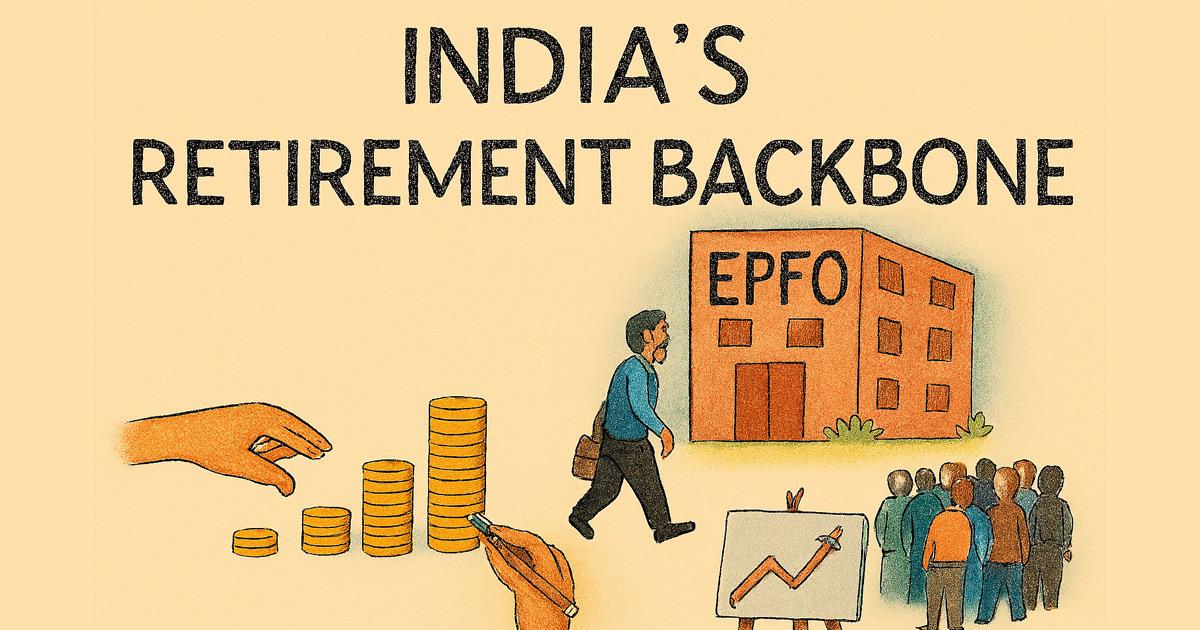
Rising stressed debt and past exposures like Reliance Capital, Yes Bank push EPFO to frame exit rules for its portfolio.
Kindly note that this illustration generated using Microsoft Copilot has only been posted for representational purposes.
Key Points
- As of December 2025, about 18.9 per cent of its investments fall under Category II, which mainly includes corporate bonds, along with exposure through other debt segments..
- Within this, the organisation is currently dealing with at least 17 downgraded securities.
- Many of the downgraded securities continue to pay interest, but their lower credit ratings have made them harder to sell.
The Employees’ Provident Fund Organisation (EPFO) is working on a formal exit policy for its investment portfolio as it addresses rising exposure to downgraded and stressed corporate debt within its more than Rs 30 trillion corpus, according to two people familiar with the matter.
EPFO’s investment book is largely focused on fixed income, with debt instruments forming a significant share.
As of December 2025, about 18.9 per cent of its investments fall under Category II, which mainly includes corporate bonds, along with exposure through other debt segments. Within this, the organisation is currently dealing with at least 17 downgraded securities, the people said.
The proposed exit policy is intended to establish an approach for handling credit downgrades and may assign portfolio managers responsibility for exit decisions.
Issues under discussion include whether investments should be sold once their rating falls below the permitted level, the extent of losses that can be accepted in market sales, and how responsibility for such decisions should be determined.
The policy is also expected to consider how such decisions affect the performance evaluation of portfolio managers, the people said.
Reliance Cap, IL&FS context
The move follows discussions within EPFO’s Investment Committee (IC), which noted the absence of a defined framework for such situations.
In earlier cases, including exposures to Reliance Capital, decisions on whether to hold or sell investments were taken on a case-by-case basis, depending on market conditions, the people said.
EPFO’s exposure to Reliance Capital exceeded Rs 33 billion at the time of its default and subsequent resolution proceedings.
It has also invested about Rs 5.8 billion in Infrastructure Leasing & Financial Services (IL&FS), where total claims, including interest, have risen to over Rs 6 billion amid an ongoing resolution process.
Other exposures, including those to Punjab State Industrial Development Corporation and Uttar Pradesh Financial Corporation, have seen delays in interest payments, in some cases extending over a decade.
Downgraded securities, liquidity issues
Many of the downgraded securities continue to pay interest, but their lower credit ratings have made them harder to sell.
Once ratings fall below investment grade, the pool of buyers becomes limited and such securities are often sold at lower prices, making exits more difficult for large investors such as EPFO, the people said.
Portfolio managers told the IC that, due to low trading volumes, buyers are usually approached directly and price indications are obtained before decisions are taken.
During the discussions, consultant Crisil presented a draft exit policy, including comparisons with approaches followed by other pension funds and examples based on cases such as Reliance Capital and Yes Bank.
It was also noted that portfolio managers have generally recommended holding downgraded securities. Some officials indicated that incentives to recommend sales may be limited.
Views within the IC differed, with some members suggesting that investments be sold once they are downgraded below the permitted level, along with setting aside funds to cover possible losses.
Others referred to the limited market for such securities, noting that sales could result in losses or may not take place. Suggestions were also made to define a decision-making process for sales involving losses.
The committee also recommended reviewing the exit policy followed by the Employees’ State Insurance Corporation and consulting external experts, including the Indian Institute of Management Kozhikode.
It directed that studies on the exit policy and investment strategy review assigned to IIM Kozhikode be completed within a defined timeline and presented in upcoming meetings.
Default norms tighten as policy takes shape
In parallel, EPFO is working on a standard operating procedure for handling default cases, including legal and recovery processes.
The committee also discussed whether government-backed securities could be held to maturity and whether this should be included in the policy.
A labour ministry official also raised concerns about the transfer of state-guaranteed securities from exempted trusts, noting that these may be downgraded later.
At present, EPFO generally seeks such transfers in cash, although existing rules allow these securities to be transferred at their original purchase price.
The proposed exit policy remains under discussion and is expected to be reviewed in upcoming IC meetings before being placed before the CBT, EPFO’s apex decision-making body. The next meetings of both the IC and the board are expected in May.
Part 1: Payslip To Pension To Long-Term Wealth: How EPF Works
Part 2: EPF Secrets Revealed: Where Your 12% Goes
Part 3: [email protected]%: Is It Really Worth It?
Part 4: How EPS Turns Part Of Your PF Into Lifelong Income
Part 5: EPF: How To Withdraw Smart, Protect Your Corpus
Part 6: Your EPF Can Fund Housing, Surgery, Education…
Part 7: Who Gets Your PF Money After You…
Part 8: How EPF Protects Your Family After You
Part 9: How EPF Compounds But Inflation…
You can ask your personal finance questions to rediffGURUS HERE