

Indian insurance companies are set to experience a dip in profitability during the January-March quarter of FY26, primarily driven by the rationalisation of goods and services tax on retail life and health policies, which has resulted in a loss of input tax credit, alongside volatile equity markets.
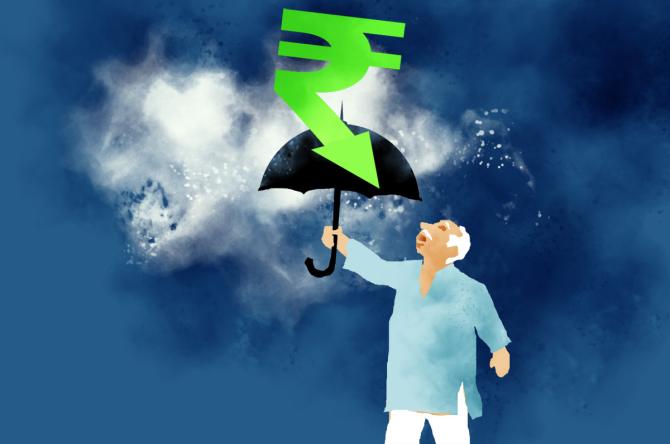
Illustration: Dominic Xavier/Rediff
Key Points
- Profitability for Indian insurance companies is expected to decline in Q4FY26 due to GST rationalisation on retail life and health policies, causing a loss of input tax credit.
- Equity market volatility is also projected to negatively impact insurers’ investment income during the quarter.
- Life insurers aim to mitigate the ITC impact by shifting towards non-linked products and leveraging rising demand for term plans.
- LIC is forecast to see a significant 25 per cent increase in Value of New Business (VNB) in Q4FY26, while HDFC Life and SBI Life expect lower or negative VNB growth.
- General insurers are likely to experience relatively lower impact, supported by demand in health and motor segments, but face challenges from subdued equity markets and future regulatory changes.
Profitability of insurance companies is expected to come under pressure in the January-March quarter of FY26 (Q4FY26), primarily due to the rationalisation of goods and services tax (GST) on retail life and health policies that has led to a loss of input tax credit (ITC), analysts said.
The impact, however, is likely to be relatively lower for general insurers, supported by a positive demand impulse in the health and motor segments following the GST cut.
Volatility in equity markets is also likely to weigh on insurers’ investment income during the quarter.
Impact on Life Insurers
According to analysts at Emkay, margins are expected to remain broadly stable, as the impact of GST-related ITC losses has already been factored in.
A correction of about 14 per cent in the Nifty during Q4, along with a roughly 10 per cent decline in the second half (H2) of FY26 and a 40-basis-point rise in bond yields, is likely to result in a negative economic variance of 4-5 per cent for private life insurers and nearly 10 per cent for Life Insurance Corporation of India (LIC) in FY26.
Life insurers are expected to partly offset the ITC impact by shifting focus to non-linked products, supported by rising demand for term plans and higher attachment rates.
“We expect the impact of ITC loss on value of new business (VNB) margins to be partly offset by a shift towards non-linked products, rising demand for term products, and improved attachment rates.”
VNB Growth Projections
“Across our coverage, VNB is likely to grow in double digits, except for HDFC Life Insurance Company, where it is projected to decline year-on-year, and SBI Life Insurance, where growth is expected to be in single digits,” Motilal Oswal said in a report.
According to the brokerage, SBI Life Insurance is likely to report a marginal 1 per cent increase in VNB in Q4FY26, compared with 9.9 per cent growth a year earlier.
HDFC Life’s VNB is expected to decline by around 6 per cent, versus 11.5 per cent growth in Q4FY25.
ICICI Prudential Life Insurance is estimated to post 12 per cent VNB growth, up from 2.45 per cent a year ago.
Meanwhile, LIC is expected to post a 25 per cent increase in VNB in Q4FY26, compared with a 3.04 per cent decline in the year-ago period.
Outlook for General Insurers
For general insurers, GST changes have supported continued growth momentum in the health and motor segments during the quarter.
Emkay expects the combined ratio to remain broadly stable, despite some impact from ITC losses.
However, subdued equity markets are likely to limit capital gains, thereby weighing on profitability.
Looking ahead, an uncertain economic and geopolitical environment could pose challenges in FY27 for general insurers, which are already grappling with pricing pressure in commercial lines and delays in motor third-party tariff hikes.
Additionally, regulatory developments, including the proposed Sabka Bima Sabki Suraksha framework, will remain key monitorables for the sector.