

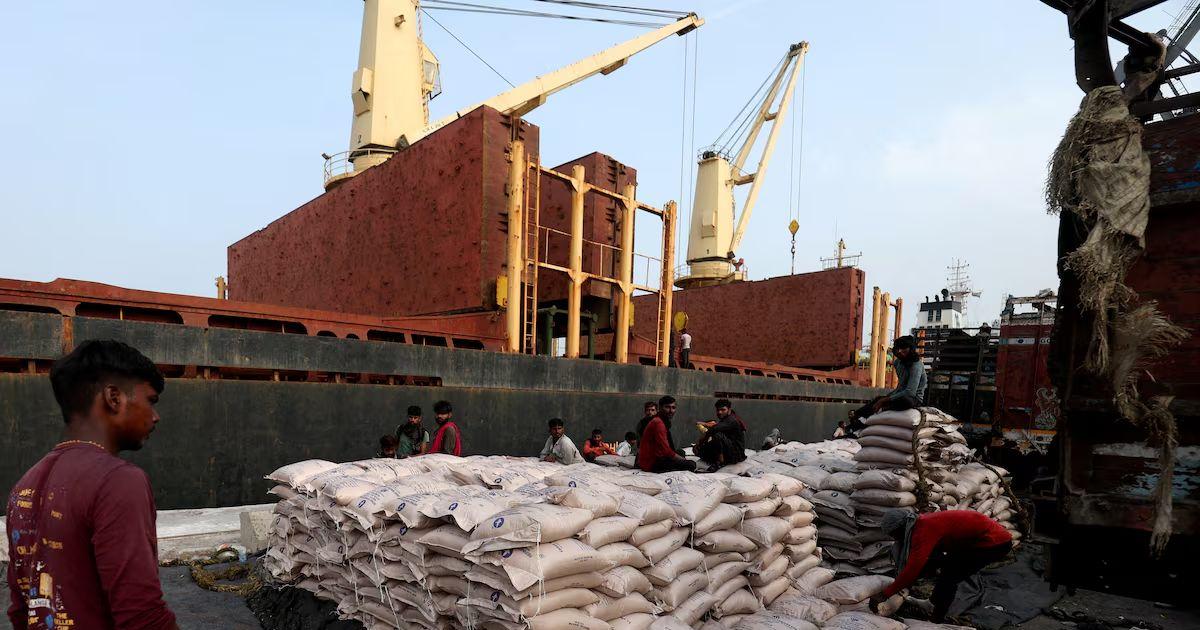
The Federation of Indian Export Organisations (FIEO) has formally requested the Reserve Bank of India (RBI) to provide crucial liquidity support to Indian exporters, who are grappling with a dramatic surge in freight costs and extended payment cycles exacerbated by the ongoing West Asia conflict.

Photograph: Amit Dave/Reuters
Key Points
- FIEO has requested the RBI to provide liquidity support to exporters due to a sharp rise in freight costs and extended payment cycles caused by the West Asia conflict.
- Freight rates to some Middle East countries have surged by 300-400 per cent, and shipment times to destinations like the US have increased from 50 to 90 days.
- The disruption has elongated payment cycles for exporters from 30-60 days to 90-120 days, increasing working capital pressure.
- SBI’s chief economic advisor, Soumya Kanti Ghosh, noted that India’s export sector has performed well despite geopolitical tensions but cautioned about fresh risks from the escalating West Asia conflict.
- Ghosh expressed optimism for India to reach the $1 trillion export milestone, highlighting the country’s strong economic position amidst global uncertainties.
The Federation of Indian Export Organisations (FIEO) has urged the Reserve Bank of India (RBI) to provide liquidity support to exporters, amid a sharp rise in freight costs due to the ongoing West Asia conflict.
The disruption has led to delays in shipments and an elongation of payment cycles, putting pressure on exporters’ working capital requirements.
Impact of Geopolitical Tensions on Logistics
“Logistic disruption has resulted in freight (rates) going up.
“In fact, freight (rate) to some of the Middle East countries has gone up to 300-400 per cent.
“It has brought pressure on air shipments also.
“Since logistics have been disrupted, the supply of goods have been delayed.
“Earlier, my ships were reaching the US coast in 50 days.
“Now, they are reaching in 90 days. The payment cycle to the exporter, which used to be 30-60 days, has elongated to 90-120 days,” said Ajay Sahai, director general and chief executive officer, FIEO.
“We require much more credit and that is why we are requesting the RBI to provide some liquidity.
“The cost of credit is also an issue. We expect the government to remove the cap that it has brought on interest subvention,” he added.
Recently, RBI decided to continue key trade relief measures introduced in November 2025 to support exporters amid ongoing geopolitical and logistical disruptions.
Sahai highlighted that India’s free trade agreement (FTA) strategy has become more focused, targeting complementary economies and key export markets.
India’s Export Resilience and Future Outlook
Separately, Soumya Kanti Ghosh, group chief economic advisor at State Bank of India, said India’s export sector has held up well despite a year marked by geopolitical tensions, tariff volatility, and supply chain disruptions, even as he cautioned that ongoing disturbances in West Asia pose fresh risks to growth and trade.
“I think it is actually a significant coincidence… I saw a tweet (post on social media platform X) that the Strait of Hormuz has been opened and crude prices have dropped to below $90 per barrel,” Ghosh said, adding that the latest export data also offered encouraging signs.
“It does not seem that there was any war last year because the exports of goods and services have actually expanded,” he noted.
Ghosh expressed optimism that India could move towards the $1 trillion exports milestone.
“The good thing is that I think we ended the year quite well, and I hope that this year will be even better,” he said.
However, he flagged rising geopolitical risks, particularly from the escalating conflict in West Asia.
This episode, he said, has evolved into a broader regional conflict, with implications for global energy markets and supply chains.
Ghosh said India entered the uncertainty triggered by the West Asia conflict from a position of relative strength, with growth around 7.6 per cent, compared with weaker starting points during past crises.