
Russian President Vladimir Putin’s visit to India this week aims to secure energy supplies, stabilise defence deliveries and ensure bilateral trade continues smoothly despite strong Western sanctions, GTRI said on Tuesday.
Image used for representation purpose only. Photograph: Kim Kyung-Hoon/Reuters
Putin will land in New Delhi on December 4 for the 23rd India-Russia Annual Summit.
“It is a high-stakes working visit shaped by necessity to lock in energy security, stabilise defence supply lines and keep bilateral trade functioning under the weight of Western sanctions,” Global Trade Research Initiative (GTRI) founder Ajay Srivastava said.
India’s current engagement with Russia rests on three pillars — energy, defence and diplomacy, he noted.
Russia has become India’s largest crude oil supplier, accounting for 30-35 per cent of total oil imports, turning discounted crude into the foundation of the partnership, he added.
Defence forms the second pillar.
The two countries may formalise a new payment framework, using dirham or integrate Russia’s SPFS system with India’s RuPay network, he said.
After Russia was partially removed from SWIFT, payments shifted to a multi-currency system, the UAE’s dirham (60-65 per cent), rupee (25- 30 per cent), and Chinese yuan (5-10 per cent).
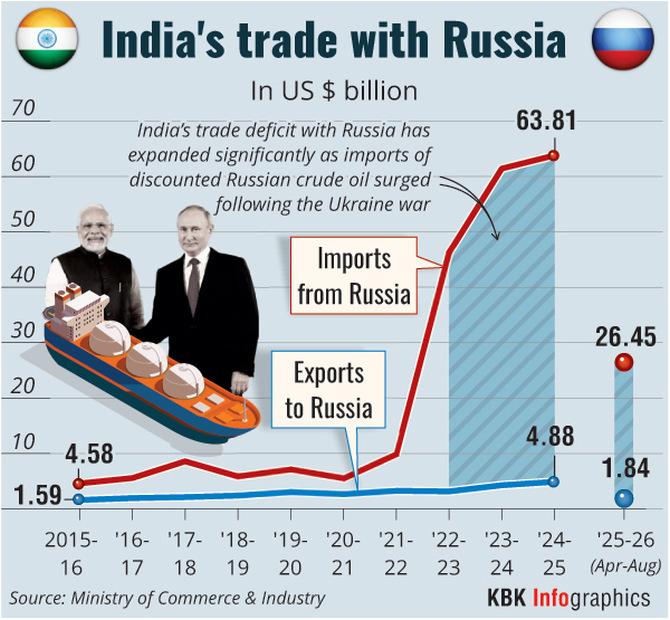
India’s merchandise trade with Russia remains sharply imbalanced, with modest export growth alongside persistently high energy-driven imports.
Exports rose from $4.3 billion in FY24 to $4.9 billion in FY25, with shipments of $2.25 billion in April-September 2025.
The export basket is narrow and skewed toward a few industrial and chemical items — machinery ($367.8 million), pharmaceuticals ($246 million) and organic chemicals ($165.8 million) — together account for most of the value in the first half of FY26.
Consumer-oriented and high-visibility categories remain marginal — smartphones ($75.9 million), Vannamei shrimp ($75.7 million), meat ($63 million) and garments at just $20.94 million — underscore India’s limited penetration in Russia’s retail markets and electronics value chains despite geopolitical churn, think tank GTRI said.
On the import side, it said dependence on Russian energy and commodities continues unabated.
India’s imports stood at $63.2 billion in FY24 and inched up to $63.8 billion in FY25; in April-September 2025 alone, imports were $31.2 billion.
Petroleum dominates overwhelmingly, led by crude oil ($23.1 billion) and petroleum products ($2.5 billion), followed by coal ($1.9 billion).
Strategic inputs such as fertilisers ($1.3 billion) and food oils — sunflower seed oil ($633 million) — remain significant, while diamonds ( $202 million) add to the non-energy bill.
“The result is a structurally asymmetric relationship as India relies on Russia for energy security and inputs, while struggling to scale value-added exports, leaving the bilateral trade equation lopsided and vulnerable to shocks in global commodity prices,” GTRI added.