

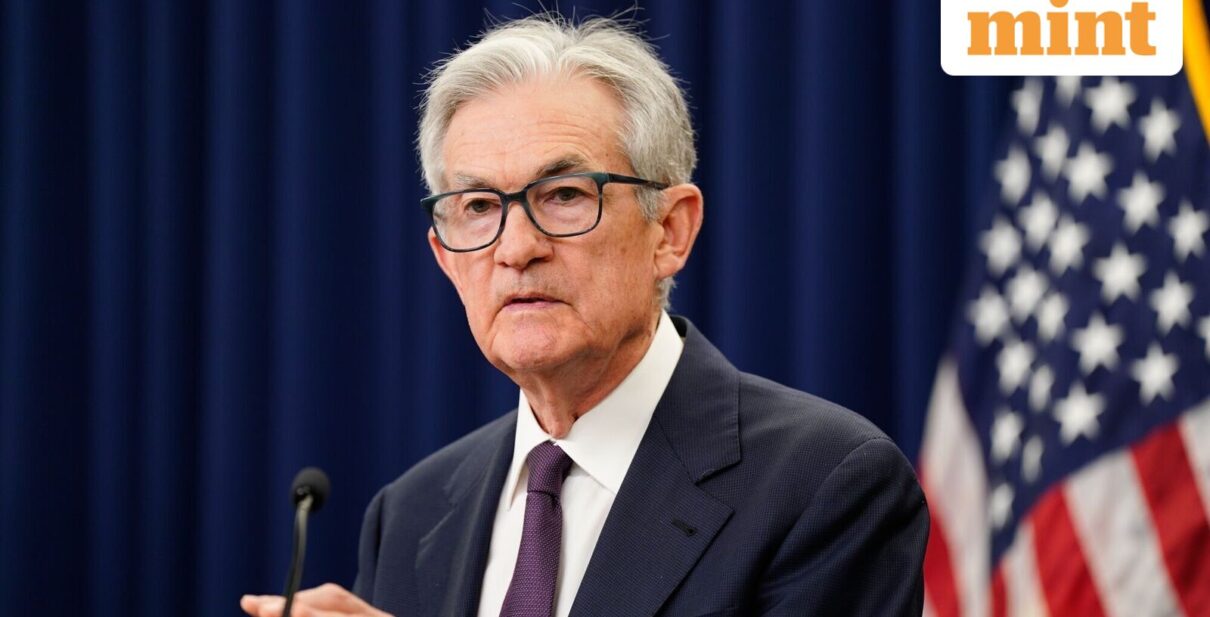
As the Indian rupee hovers near record lows, currency traders are keenly awaiting the US Federal Reserve’s policy decision on Wednesday, December 10, with hope that a 25-basis-point rate cut, accompanied by a dovish tone from Chair Jerome Powell, will weaken the US dollar and lend support to the Indian currency.
The rupee gained 17 paise at 89.88 against the US dollar on Tuesday, amid softness in the US currency and crude oil prices. The domestic currency dropped to its record low of 90.46 per dollar on December 4, primarily due to persisting uncertainties over an India-US trade deal, and relentless foreign capital outflow.
Meanwhile, India and the US will begin their three-day talks on the first phase of their proposed bilateral trade agreement from December 10.
US Fed meeting: Market hopes for a 25 bps rate cut
Market participants seem to have discounted the possibility of a 25-basis-point (bps) US Fed rate cut on Wednesday despite mixed US macroeconomic indicators.
According to CME’s FedWatch Tool, traders see an 89% chance of a 25-basis-point rate cut on Wednesday.
The Fed’s preferred inflation gauge, Personal Consumption Expenditures (PCE) Price Index, remained largely in line with expectations in September. The PCE index increased 0.3% in September after rising 0.3% in August. Year-on-year, the PCE Price Index increased 2.8% after rising 2.7% in August.
On the other hand, private payrolls saw their sharpest fall in more than two and a half years to 32,000 in November, but jobless claims fell to a three-year low to 1,91,000 for the week ended November 28.
“Comerica Economics forecasts for the Federal Open Market Committee (FOMC) to cut the federal funds target a quarter of a percentage point to a range of 3.50% and 3.75% at its last decision of the year this Wednesday. Several FOMC members will likely dissent again,” said Bill Adams, Chief Economist for Comerica Bank.
“The Fed will likely be tight-lipped about the outlook for rates in 2026, given conflicting views among FOMC members. The FOMC probably will signal measures to support short-term funding markets after signs of tight liquidity in them in recent months,” said Adams.
Can a rate cut boost the Indian rupee?
Experts believe a 25 bps rate cut may influence sentiment and support the domestic currency to some extent.
“The US Federal Reserve is expected to reduce the federal funds rate by 25 basis points. A rate cut would be broadly supportive for Indian equities, as lower US rates typically buoy global risk appetite, improve equity valuations, and stimulate demand in the US economy,” said Sujan Hajra, Chief Economist & Executive Director, Anand Rathi Group.
“Additionally, the move could ease depreciation pressures on the Indian rupee by narrowing the interest rate differential, thereby improving foreign capital flows into emerging markets,” said Hajra.
However, some experts believe that a rate cut is fairly discounted, and the market may see a limited impact of the policy move.
“A 25 bps Fed rate cut will ease US financial conditions, but its impact on India is likely to remain balanced. The rupee may not move meaningfully, as any support from a softer dollar could be offset by commodity prices and domestic macro factors,” said Ajit Mishra, SVP- Research at Religare Broking.
Mishra underscored that equity sentiment generally improves when global liquidity rises, but actual flows will depend more on the Fed’s forward guidance than on a single rate cut.
“Interest-rate-sensitive sectors may benefit, while exporters could see mild pressure if the rupee firms,” said Mishra.
Anindya Banerjee, the head of currency and commodity at Kotak Securities, also believes a 25 bps rate cut is already fully priced in by global markets; the real catalyst will be the tone and forward guidance.
“A dovish pivot strengthens the rupee; a hawkish tone pressures it. In the near term, USD-INR is likely to trade within a broad 89.50–91.00 range. The directional breakout will depend entirely on the Fed’s guidance, not the 25 bps cut itself,” said Banerjee.
Banerjee said if the Fed sounds dovish, the dollar would weaken and the Indian stock market may see stronger foreign inflows. In this case, the rupee could move toward 89.50.
However, if the Fed delivers a hawkish cut, then the US dollar would strengthen, and the risk sentiment may weaken. Indian equities may see mild outflows, and the rupee could move toward 91.00, said Banerjee.
Read all market-related news here
Read more stories by Nishant Kumar
Disclaimer: This story is for educational purposes only. The views and recommendations expressed are those of individual analysts or broking firms, not Mint. We advise investors to consult with certified experts before making any investment decisions, as market conditions can change rapidly and circumstances may vary.