

‘Every day the meter is ticking. Like a time bomb.’
Shipping giants are billing Indian exporters up to $3,000 per container in war surcharges — on cargo that sailed before the war began — as the Strait of Hormuz shuts down.

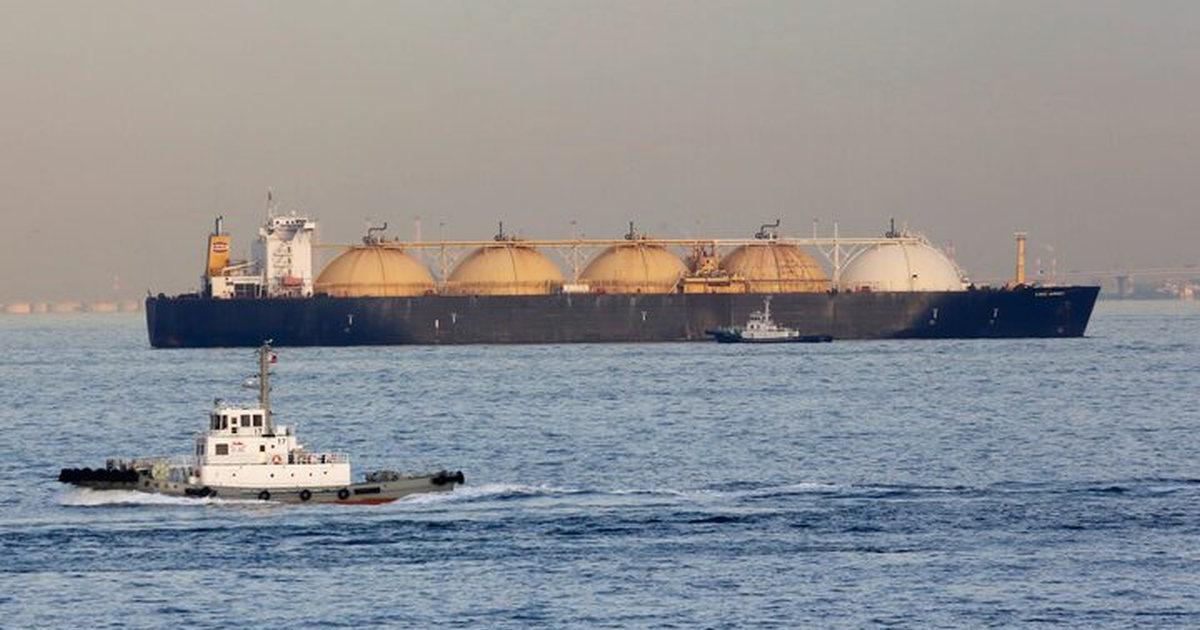
IMAGE: Indian LPG carrier Shivalik arrives at Mundra port via the Strait of Hormuz, amid the US-Israel conflict with Iran, March 16, 2026. Photograph: Amit Dave/Reuters
On the morning of February 28, 2026, the US and Israeli forces struck Iranian military targets. Around 20% of global oil and a similar share of LNG normally transit the Strait of Hormuz.
Within hours, that corridor had effectively shut. According to Alphaliner (a leading global shipping data and analytics firm), 138 container ships were trapped in the Persian Gulf by March 2, accounting for nearly 470,000 TEUs (Twenty-foot Equivalent Unit, the standard measure for container ship capacity) of capacity.
Key Points
- Shipping giants — led by CMA CGM and Hapag-Lloyd — imposed war surcharges of up to $3,000 per container from March 2, 2026, applying them retrospectively to cargo already at sea when the US-Israel strikes on Iran began on February 28. Maersk and MSC followed with its emergency freight increases and surcharges in subsequent days.
- Indian exporters shipping minerals, chemicals and perishables to the Gulf face a 300% to 400% spike in shipping costs, with over 50 containers from Ashapura Minechem alone stranded at ports like Jebel Ali and Khor Fakkan.
- Small exporters are the hardest hit: The war surcharge is identical regardless of cargo value, meaning an exporter with $2,000 worth of goods faces the same $3,000 surcharge demand as a listed conglomerate shipping crores of rupees of cargo.
- Exporters have no legal shield: Shipping lines are protected by force majeure clauses, war risk is excluded from standard export insurance, and no Indian regulatory body — not the DG Shipping, not the commerce ministry, not trade associations — has taken effective action.
- The crisis threatens a cascade beyond exporters: Perishable goods bound for the Gulf during Ramadan risk rotting in Indian ports, pushing down farm prices at home, while delayed payments risk triggering mandatory RBI reporting and working capital crises for thousands of small businesses.
MSC — Mediterranean Shipping Company, the world’s largest container shipping line by fleet size — instructed all vessels in the Gulf to proceed to designated safe shelter areas.
Maersk suspended all new bookings between the India subcontinent and the Upper Gulf markets of the UAE, Bahrain, Qatar, Iraq, Kuwait and Saudi Arabia.
CMA CGM instructed all vessels in or coming into the Gulf to proceed to shelter and suspended Suez Canal passage, rerouting vessels via the Cape of Good Hope.
Then came the bills: For Indian exporters, levied on cargo that had sailed before February 28, days before a single shot was fired.
The Federation of Freight Forwarders’ Associations in India has noted that several carriers introduced war risk surcharges ranging from $1,500 for standard containers to up to $4,000 for refrigerated units — on top of standard freight charges.
The surcharge, critically and which is the biggest woe of exporters today, was applied retrospectively to cargo already at sea.
Three exporters — a mineral giant, a chemicals manufacturer and a retired entrepreneur who spoke with Rediff — tell the same story.
‘At least 300% to 400%, the cost of shipping has gone up’
Avijit Mukherjee, CEO of Ashapura Minechem, one of India’s largest non-metallic mineral exporters, ships nearly 2,000 containers a month from Mundra port. Between 30% and 40% go to the Gulf — bauxite, bentonite and kaolin to the drilling, foundry and construction industries of Kuwait, Dammam and the UAE. Over 50 containers are now stranded mid-sea or at ports like Jebel Ali and Khor Fakkan.
“All shipments inside the Persian Gulf are not going currently because they are coming under the war zone,” says Mukherjee. “Whatever had been shipped already before the war is also stuck.”
The demand: $2,000 per container as a war insurance charge, on top of the normal freight of $150. “At least 300% to 400%, the cost of shipping has gone up,” Mukherjee says. “We will be facing a huge loss as well as complete stoppage of shipments going to the Middle East.”
He is angry, too, at the legal cover being invoked — a 19th century maritime framework that separates ‘risks of the seas’ from ‘risks of men’ — applied to cargo that sailed in peacetime.
“We are in the 21st century,” he says. “Something which is already shipped before the war — nobody knew the war was going to start. How do you penalise the shipper for it?” Ashapura has written to both the ministry of shipping and the commerce ministry. “I still have not heard anything back,” Mukherjee says.
‘A lot of perishable goods get exported to the Middle East because of Ramadan, so…’
Yatin Sheth, CEO of Acume Chemicals in Thane, makes bromine derivatives for oil drilling, agrochemicals and pharmaceuticals. His 10-container shipment — worth around Rs 5 crore (Rs 50 million) — left Port Hazira on February 28. The war began the next day.
“They said whatever containers left prior to March 1 also have to pay additional surcharge — $2,000 per container, that is Rs 20 lakhs (Rs 2 million) — otherwise they will not release the bill of lading,” Sheth says.
Without the bill of lading, his UAE customer cannot take delivery. It is not a request. It is a hostage situation. “Generally, this is the first time they have levied it retrospectively,” he adds.
He was fortunate — his customer agreed to split the surcharge 50-50. Most exporters won’t be so lucky. Significantly, the surcharge is blind to the value of what is inside the container, hitting a micro-exporter with $2,000 worth of goods with the same $2,000 demand as a listed conglomerate.
“There are more than 10,000 exporters who export one or two containers a month,” Sheth says. “If they pay this war surcharge, their working capital will get affected.”
The timing makes this especially cruel: Indian ports handle significant volumes of fruits, vegetables, meat and other foodstuffs for the Gulf, particularly during the month of Ramadan.
“A lot of perishable goods get exported to the Middle East because of Ramadan,” Sheth says. “If perishable cargo cannot go, fruits and vegetables will get thrown in the Indian market, prices will drop, and farmers and traders will lose heavily.”
He also warns of an RBI compliance crisis: “If we don’t get payment in 180 days, we have to report to the RBI. We need a relaxation from RBI for shipments during this period.” He has filed with the commerce ministry, FICCI and Chemexil. The response has been silence.
‘No shipping line is willing to honour its contract’
Geetha Nerurkar, the former CEO and executive director of Ashapura Minechem, who set up a small minerals export firm after retirement, had a container worth less than $2,000. Her freight cost: $250 per container.
Even before her cargo could sail, Maersk demanded a $3,000 war surcharge on every container — not as a condition for releasing a bill of lading, but simply as a precondition for allowing the shipment to move at all. There was no negotiation, no notice, no explanation beyond the fact of a war that had just begun.
The value of her cargo was less than $2,000. Paying $3,000 per container before the goods had even left the yard was simply impossible. She withdrew the consignment.
Maersk then hit her with $1,200 in detention charges and refused to accept the empty containers back until those charges were paid in full. The containers now sit in a private yard, with Nerurkar paying storage costs every single day.
The principle she states is clear and unambiguous: “Once we have given the consignment to the shipping line, along with payment of the freight, it is the shipping line’s responsibility to deliver the goods. That is the contract.”
“No shipping line is willing to honour its contract. When all exporters are committed to honouring their contracts why should the shipping lines be any exception?” she asks.
Strangely, the insurance that exporters take to cover their risks offers no protection here either. “It is like a broken umbrella,” Nerurkar says. “They say war risk is not covered. Exporters are left without any shelter — without any protection.”
She has filed protest letters with the director general shipping, the ministry of commerce, Competition Commission of India and the Small Chambers of Commerce — going from pillar to post through a maze of bureaucracy.
DG Shipping told her it governs ship and passenger safety, not commercial disputes. The ministry of commerce has not responded. Trade associations, though they exist precisely to represent exporters collectively, asked her to come as a group before they would act.
S C Ralhan, president of the Federation of Indian Export Organisations, has stated that shipping lines should avoid taking undue advantage of the crisis.
For Nerurkar, though, nothing has changed on the ground.
“These people are not governed by Indian rules and regulations — that is what they say,” Nerurkar says about the shipping lines’ response. “Every day the meter is ticking. Like a time bomb.”