
Cumulatively during April-January 2025-26 fiscal, India’s exports rose by 2.22 per cent to $366.63 billion.
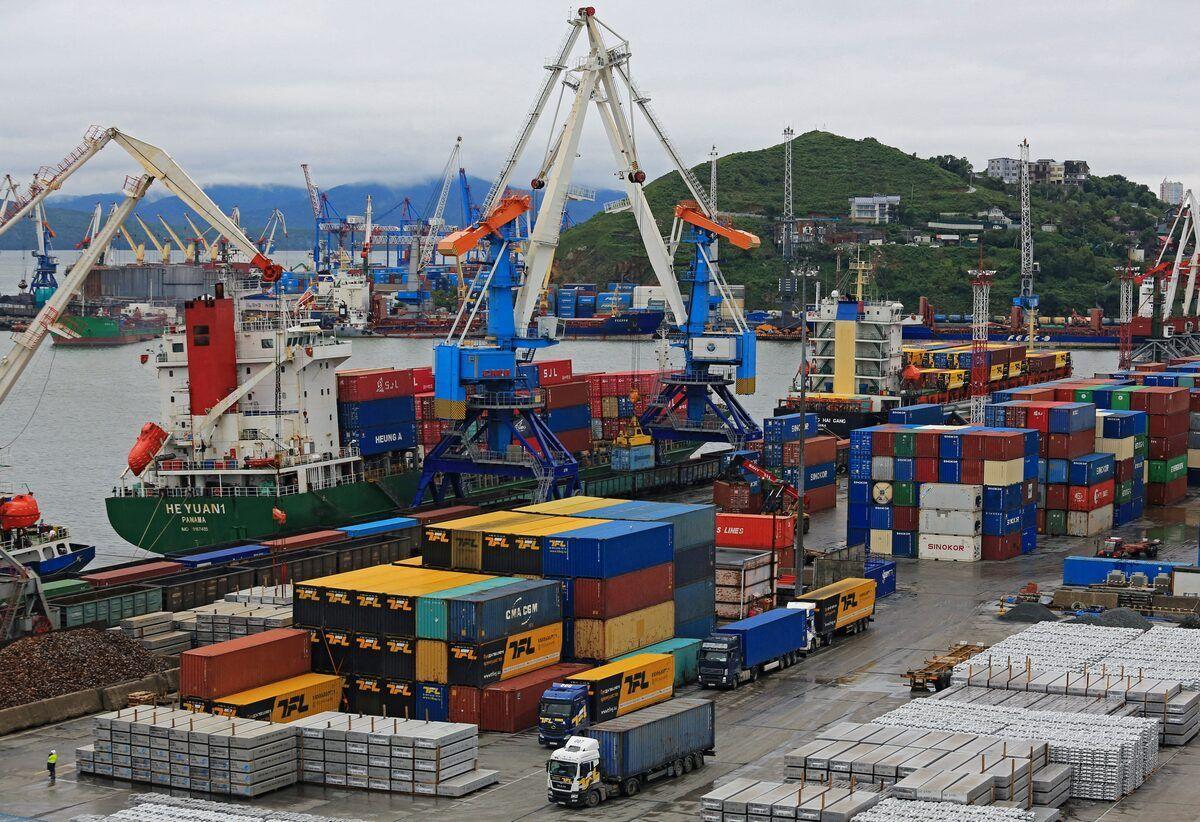
Photograph: Tatiana Meel/Reuters
Key Points
- Cumulatively during April-January 2025-26 fiscal, the country’s exports rose by 2.22 per cent
- Imports grew 7.21 per cent to $649.86 billion
- global trade has been disrupted due to tariffs imposed by the US
The country’s exports rose marginally by 0.61 per cent to $36.56 billion in January, while trade deficit widened to a three-month high of $34.68 billion, government data showed on Monday.
Imports rose 19.2 per cent – the highest so far this fiscal – to a three-month high of $71.24 billion in January, driven by a sharp rise in inbound shipments of gold and silver due to higher prices.
Gold imports
Gold imports surged 349.22 per cent to $12 billion during the month under review, while silver imports jumped by 127 per cent to $2 billion.
India mainly imports the yellow metal from Switzerland, from where the inbound shipments have climbed 836.85 per cent to $3.95 billion in January.
Oil imports, however, dipped 0.24 per cent to $13.4 billion in January.
Cumulatively during April-January 2025-26 fiscal, the country’s exports rose by 2.22 per cent to $366.63 billion.
Imports grew 7.21 per cent to $649.86 billion, leaving a trade deficit of $283.23 billion during the nine-month period of 2025-26.
The gap was $247.38 billion in April-January 2024-25.
Briefing media on the data, commerce secretary Rajesh Agrawal said the country’s exports “remain northwards” both in goods and services.
He expressed hope that, going by the trend, exports of goods and services are likely to cross $860 billion in 2025-26.
It was $825 billion in 2024-25.
“In services, we will be crossing beyond $410 billion for the first time in this current year,” Agrawal said.
Total exports
During April-January this fiscal, the total exports are estimated at $720.76 billion as against $679.02 billion recorded in the same period of the previous fiscal.
The global trade has been disrupted due to tariffs imposed by the US.
On India, the Trump administration has levied a steep 50 per cent tariffs from August.
This is impacting the country’s outbound shipments from the labour-intensive sectors, such as apparel.
The US has removed a 25 per cent tariff on Indian goods from February 7.
It will cut the remaining 25 per cent reciprocal tariffs to 18 per cent once a trade agreement is finalised between the two countries.
Sectors that registered positive and negative growth
At the exports front, key sectors such as petroleum, engineering, electronics, iron ore, marine and coffee have recorded positive growth in January.
However, shipments of tea, rice, spices, leather and leather products, gems and jewellery, chemicals, ready-made garments of all textiles, and plastics have recorded negative growth.
As per the commerce ministry data, services exports for January this year are estimated at $43.90 billion as compared to $34.75 billion in January 2025.

The estimated value of services imports for January 2026 is $19.60 billion as compared to $16.71 billion in the same month last year.
Commenting on the data, Apparel Export Promotion Council (AEPC) chairman A Sakthivel said he met RBI Governor Sanjay Malhotra and requested for a separate export policy for the MSMEs sector.

He proposed that a dedicated Special Interest Package Scheme be introduced for MSMEs, as currently, banks determine lending rates based on their internal policies and balance sheet considerations, leading to inconsistencies and higher borrowing costs.
Federation of Indian Export Organisations (FIEO) president S C Ralhan expressed confidence that with sustained policy support, improved market access under the new FTAs and continued industry resilience, India is well-positioned to maintain its export growth momentum and further strengthen its role as a reliable and competitive partner in global trade.