

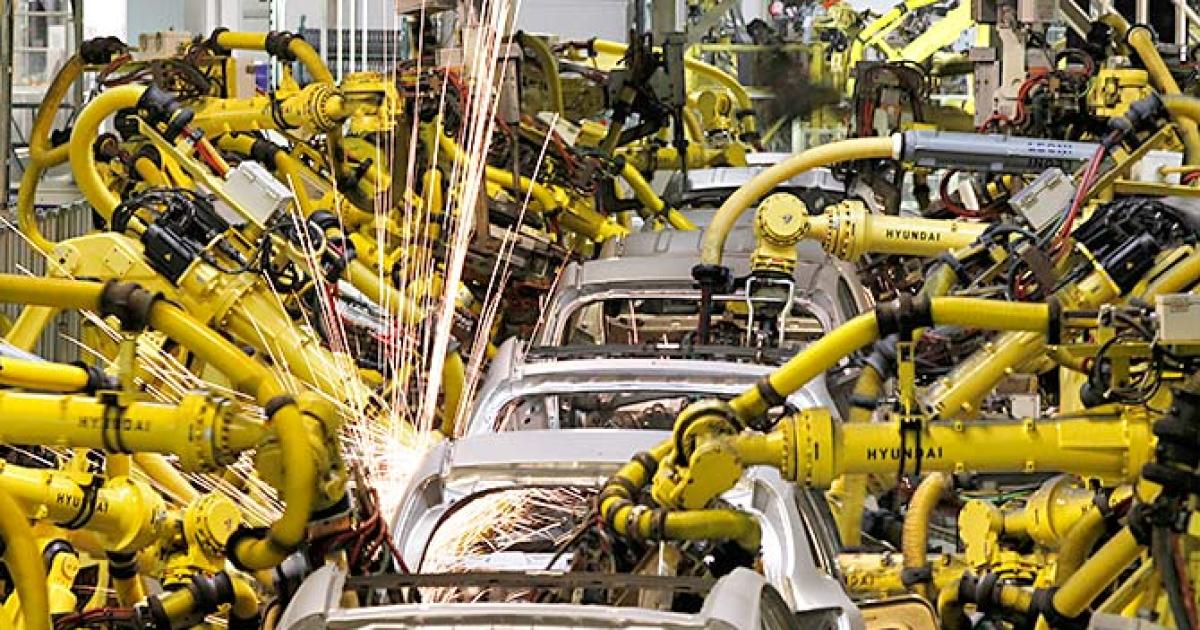
India’s passenger vehicle market reached unprecedented heights in FY26, with sales soaring to a record 4.7 million units, fueled by GST 2.0 and robust performances from leading automakers.
Photograph: Petr Josek/Reuters
Key Points
- India’s passenger vehicle sales hit a record 4.7 million units in FY26, driven by strong performances from Maruti Suzuki, Tata Motors, and Mahindra & Mahindra.
- The implementation of GST 2.0 in September 2025 acted as a ‘demand unlock’, significantly boosting sales in the second half of the fiscal year.
- Automakers are closely monitoring geopolitical developments and commodity price increases, which could impact supply chains and lead to price hikes.
- Tata Motors achieved its highest-ever annual sales volumes, growing 15% year-on-year and becoming the number 2 ranked player in the industry in H2 FY26.
- Despite geopolitical uncertainties, Hyundai Motor India anticipates a strong FY27, focusing on innovative and connected products.
Passenger vehicle sales in India scaled a new high of 47 lakh units in 2025-26, riding on record performance by automakers such as Maruti Suzuki India, Tata Motors and Mahindra & Mahindra with GST 2.0 revving up sales in the second half of the fiscal.
While the industry is looking forward to carrying forward the sales momentum in the new fiscal, it is closely monitoring the West Asia war to mitigate potential supply-side risks and the possibility of impact on demand due to price hikes taken to offset rise in commodity prices.
The year 2025-26 was a year of two halves with a challenging first half followed by a boost in the second half with GST rate reduction in September 2025 acting as a “demand unlock”, ultimately helping the industry clock sales of around 47 lakh units, Maruti Suzuki India Senior Executive Officer, Marketing & Sales, Partho Banerjee told reporters in a virtual interaction.
In 2024-25, the total industry PV sales were at around 43.4 lakh units, he added.
He said the tailwinds of rebate in income tax, repo rate cut by RBI along with GST 2.0 continue to drive the PV sales but there is a headwind of commodity price increase, which will force automakers, including Maruti Suzuki to hike prices and it could have an impact on price sensitive segment such as the small cars.
The company will soon take a call to hike prices to partially pass on the impact of commodity price rise, he said.
Banerjee said for Maruti Suzuki,”For the whole year we have done the highest ever sales of 24,22,713 units. It’s the highest ever in the history of Maruti…had Maruti been a country, it would have been the sixth largest country in the world (in terms of PV sales), after the five major big countries.”
In 2024-25, the company’s sales were at 22,34,266 units.
Tata Motors and Mahindra & Mahindra’s Performance
Tata Motors Passenger Vehicles Ltd MD and CEO Shailesh Chandra said,”PV industry sales are expected to reach record volumes of 4.7 million units for the year, reflecting 8 per cent year-on-year (YoY) growth.”
The industry witnessed a strong rebound in the second half, posting double-digit growth, supported by GST 2.0 implementation and a robust festive season, he added.
Terming FY26 as a landmark year for Tata Motors Passenger Vehicles marked by multiple milestones, Chandra said,”We achieved our highest-ever annual sales volumes of over 6.4 lakh units, delivering industry beating growth of 15 per cent YoY and ended it with strong positive momentum, emerging as the number 2 ranked player in the industry based on Vahan registrations in H2.”
Looking ahead, he said industry momentum is expected to sustain, led by growth in SUVs, CNG and EV.
“At the same time, the industry will need to closely monitor geopolitical developments to mitigate potential supply-side risks,” Chandra said.
Another homegrown player, Mahindra & Mahindra also posted PV sales of 6,60,276 units in FY 26 as against 5,51,487 units in FY25, a growth of 20 per cent.
“The financial year ended on a very positive note, with Mahindra clocking its highest-ever volumes in both SUVs and LCVs (above 3.5T) segments, a significant milestone for the company,” M&M Ltd CEO, Automotive Division, Nalinikanth Gollagunta said.
Other Automakers’ Sales Growth
Toyota Kirloskar Motor (TKM) reported a 20 per cent growth in FY25-26 sales at 4,06,081 units as compared to 3,37,148 units in FY24-25.
“We delivered a positive performance this financial year, driven by sustained demand across our SUV, MPV and compact segments,” TKM Executive Vice President, Sales-Service-Used Car Business, Sabari Manohar said.
Hyundai Motor India Ltd (HMIL) reported total sales of 2,08,275 units in the January to March 2026 period, a growth of 8.7 per cent as compared to the year-ago period.
Commenting on the sales performance, HMIL MD & CEO Tarun Garg said, “Continuing the momentum gained in 2026, we have achieved the highest-ever quarterly domestic sales of 1,66,578 units in Q4 FY2025-26.”
On the outlook, Garg said the company stays “mindful of the prevailing geopolitical uncertainties” but is well-prepared for a strong FY2026-27, delivering aspirational, connected and innovative products.
Kia India said it delivered its strongest-ever quarterly performance, with Q1 (January-March) 2026 sales at 84,316 units, a growth of 11.6 per cent over 75,576 units in Q1 2025.
Skoda Auto India also reported its highest-ever quarterly sales in January-March, 2026 period with 20,028 units, a growth of 17 per cent over the 17,138 units sold in the same period last year.