

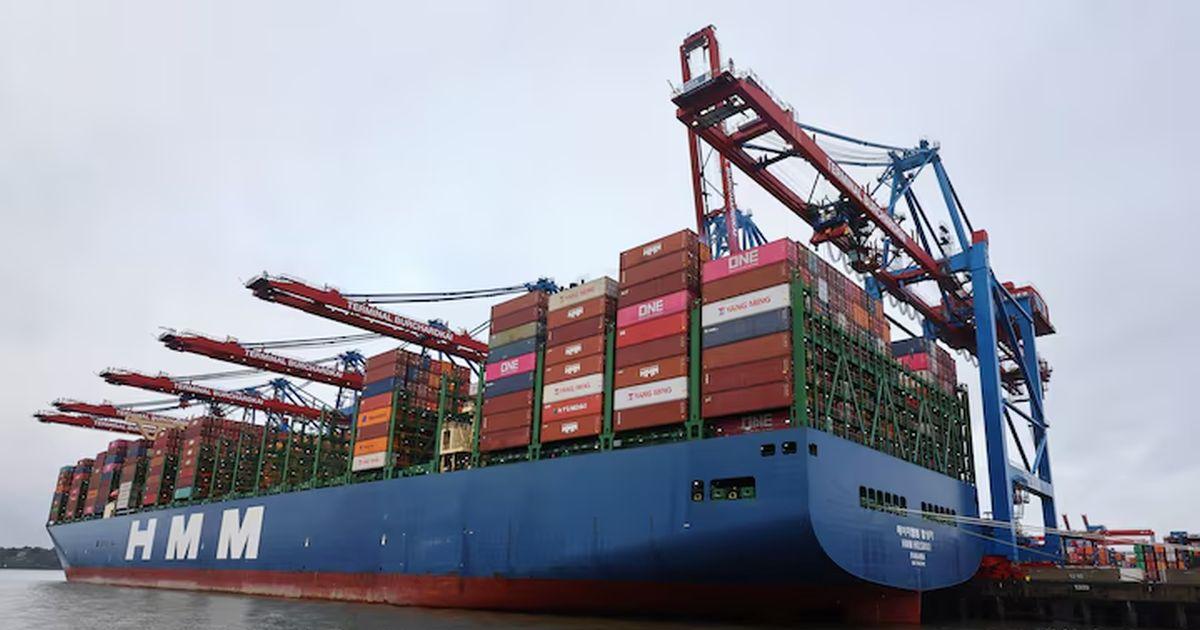
India’s February trade data reveals a slight dip in exports and a surge in imports, with the looming West Asia crisis poised to further disrupt trade dynamics and increase economic uncertainty.
Photograph: Wolfgang Rattay/Reuters
Key Points
- India’s merchandise exports decreased marginally by 0.81% in February, reaching $36.61 billion.
- Imports surged by 24.11% to $63.71 billion, driven by significant increases in gold and silver imports.
- The trade deficit narrowed compared to the previous month but widened year-on-year, reaching $27.1 billion.
- The West Asia crisis is expected to negatively impact India’s exports in March due to logistical challenges and rising freight costs.
- Key export sectors like petroleum, plastics, and textiles experienced negative growth, while rice, marine products, and pharmaceuticals saw positive growth.
The country’s merchandise exports dropped marginally by 0.81 per cent year-on-year to $36.61 billion in February, and the trade deficit narrowed to $27.1 billion compared to the previous month.
The impact of the West Asia crisis will be known in the data for the month of March, as the war began on February 28. The data will be released by mid-May.
Commerce Secretary Rajesh Agarwal said exports in March will see a “southward” trend due to the logistical challenges amidst geopolitical tensions.
The joint attack launched by the US and Israel on Iran has disrupted the movement of consignments in international waters. It has led to a significant jump in oil prices, due to which air and ocean freight have risen sharply.
Imports in February increased by 24.11 per cent to $63.71 billion due to a jump in gold and silver imports. Inbound shipments of gold rose 218.55 per cent to $7.44 billion, while silver imports were up by 285.23 per cent to $1.66 billion.

India mainly imports the yellow metal from Switzerland, from where the inbound shipments have climbed 719.3 per cent to $2.71 billion in February.
Oil imports were up 9 per cent to $12.97 billion during the month.
The trade deficit has narrowed when compared to the previous month, when it was $34.68 billion. However, the gap has widened year-on-year from $14.05 billion recorded in February 2025.
Briefing the media on the trade data, Agrawal said that the country’s exports are doing well despite global economic challenges.
He said that the country’s exports during the April-February period of FY26 went up 1.84 per cent to $402.93 billion. Imports rose 8.53 per cent to $713.53 billion during the period.

Merchandise trade deficit during the 11-month period of 2025-26 has increased to $310.60 billion as compared to $261.80 billion in the same month last year.
He added that the conflict will impact the country’s exports to West Asia.
“…there are logistical challenges. Movement of ships…even air cargo also must face certain challenges because of some disruption in flights. So, it will have some impact.
“Indian exports to that region will suffer, and their imports from India will also suffer because they are also dependent on India for multiple product categories,” he said.
Agrawal said both sides are engaged to find solutions, which can address some of these challenges.
He informed that the government is regularly taking feedback from exporters and are looking at ways to resolve them.
On overall export numbers, he said, “definitely”, there will be some impact.
“At least there will be some impact on the potential exports….Overall export numbers that you are seeing, we have been holding that combined goods and services, we will be around 860 billion dollars… I am sure we will remain in positive territory,” he told reporters.
When asked about India’s imports from Russia, the secretary said: “We are buying Russian oil also…there has been an increased buying from Russian oil also, in the current month also, because of challenges we are facing.”
Sector Performance
At the exports front, key sectors such as petroleum, plastics, textiles, leather goods, iron ore, spices, cashew, oil meals, oil seeds, and tea recorded negative growth in February.
However, shipments of rice, marine products, gems and jewellery, pharma, chemicals, engineering, and electronics have recorded positive growth.
As per the commerce ministry data, services exports are estimated at $39.53 billion as compared to $31.65 billion in January 2025.
The imports are estimated at $16.38 billion as compared to $14.51 billion in the same month last year.
India-US Trade Deal
Speaking about the progress on the India-US trade deal, the commerce secretary said that the actual signing of the pact will be done when the new architecture of tariffs is in place.
“We are talking right now on the details with the US,” Agrawal said.
Last month, both the US and India agreed on a framework for a trade deal.
Industry Reaction
Commenting on the data, Federation of Indian Export Organisations (FIEO President S C Ralhan said the escalating conflict in the Middle East has heightened global trade uncertainty.
“Disruptions in key maritime routes, including the Strait of Hormuz and the Red Sea, have forced vessels to reroute, increasing freight costs, insurance premiums, and transit times, thereby adding pressure on exporters,” he said.
He added that close monitoring of geopolitical developments, maintaining smooth logistics connectivity and providing timely policy support will be essential to sustain export momentum.


