

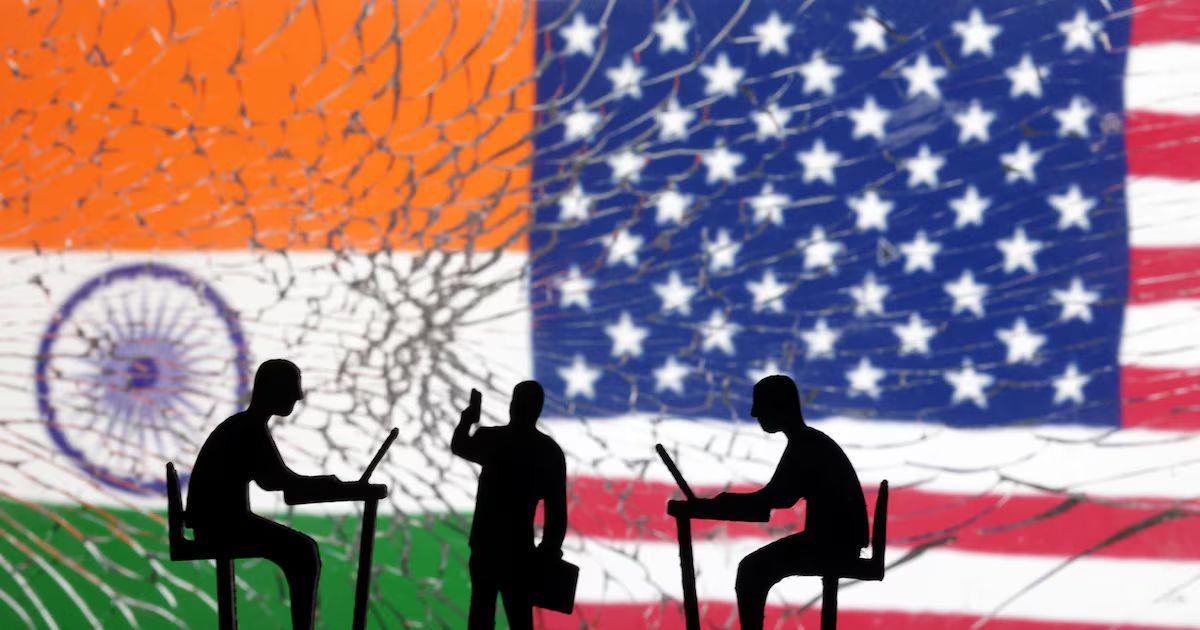
In spite of recent tariff changes and a temporary slowdown in discussions, India and the United States are committed to advancing and finalising an interim trade agreement aimed at opening markets and reducing trade barriers, as highlighted in a recent US government report.
Illustration: Dado Ruvic/Reuters
Key Points
- India and the US are actively working towards finalising an interim trade agreement, building on a framework established in February 2026.
- Talks for the trade deal slowed after the US Supreme Court revoked President Trump’s authority for country-specific tariffs and the subsequent imposition of a blanket 10 per cent surcharge.
- India decided to postpone signing the interim trade deal until the US administration establishes a new global tariff architecture.
- The USTR report notes India maintains high import tariffs on various goods, including automobiles, agricultural products, and alcoholic beverages, with an average applied tariff rate of 16.2 per cent in 2024.
- India also employs various non-tariff barriers, such as banned items, non-automatic import licences, and government trading monopolies for certain products.
India and the United States (US) issued a joint statement on a framework for an interim agreement on February 6, 2026, where both sides said they would work towards finalising the interim agreement, said a report released by the US government.
The two countries had aimed to sign the trade deal by March but talks have slowed after some key developments.
Challenges to the Interim Agreement
This mainly includes the US Supreme Court revoking on February 20 President Donald Trump’s authority to use the International Emergency Economic Powers Act (IEEPA) for imposing country-specific “reciprocal” tariffs.
Thereafter, from February 24, the US administration imposed a blanket 10 per cent surcharge on all countries for 150 days.
As a result, India decided to ‘wait’ to sign the interim trade deal with the US till the administration is ‘ready’ with the new global tariff architecture.
“In March 2025, the US and India finalised the scope of the bilateral trade agreement (BTA) negotiations, which focus on opening the Indian market for US products by reducing tariffs, eliminating non-tariff barriers (NTBs), and securing rules-based commitments in several areas to ensure long-term benefits.
“On February 6, 2026, the US and India issued a joint statement on a framework for an interim agreement regarding reciprocal and mutually-beneficial trade.
“Both sides will continue to work toward finalising the interim agreement,” the US Trade Representative (USTR) said in an annual report.
India’s Tariff Landscape
The National Trade Estimate report on Foreign Trade Barriers released by the USTR said India has ‘maintained’ import tariffs in sectors such as automobiles, agricultural goods, processed food, medicines and alcohol.
India’s average applied tariff rate was 16.2 per cent in 2024 (down from 17 per cent in 2023), with an average rate of 13 per cent for non-agricultural goods and 36.7 per cent for agricultural goods.
“India maintains high applied tariffs on a wide range of goods, including vegetable oils (as high as 45 per cent); apples, corn, and motorcycles (50 per cent); automobiles and flowers (60 per cent); natural rubber (70 per cent); coffee, raisins, and walnuts (100 per cent); and alcoholic beverages (150 per cent).
“In addition, India maintains very high basic Customs duties (in some cases exceeding 20 per cent) on drug formulations, including life-saving drugs and finished medicines,” the USTR report said.
Tariff Reductions and Non-Tariff Barriers
The report also pointed out that in its 2025-2026 Budget, India reduced applied tariffs on a range of products across multiple sectors, including lifesaving medicines, raw materials and components for electric vehicles and mobile phone battery manufacturing.
They also include critical minerals such as lithium-ion battery scrap, cobalt powder, lead and zinc, raw materials for shipbuilding, electronic components (such as open cell displays), mobile phone parts, other industrial inputs, and other industrial intermediates.
This was to support manufacturing and reduce costs for key industries, it said.
It further said India ‘maintains’ various forms of non-tariff barriers: Banned or prohibited items that are denied entry into India.
Some items require a non-automatic import licence in the case of certain livestock products, pharmaceuticals, certain chemicals, and certain information technology products.
Others are importable only by government trading monopolies and are subject to Cabinet approval regarding import timing and quantity, such as corn under a tariff-rate quota.

