

India Inc on Sunday hailed the Union Budget 2026-27 as a ‘structural shift’ in the country’s technology landscape, noting that the government is moving beyond fragmented pilots to build foundational layers where AI serves as a ‘horizontal enabler’ for the entire economy.

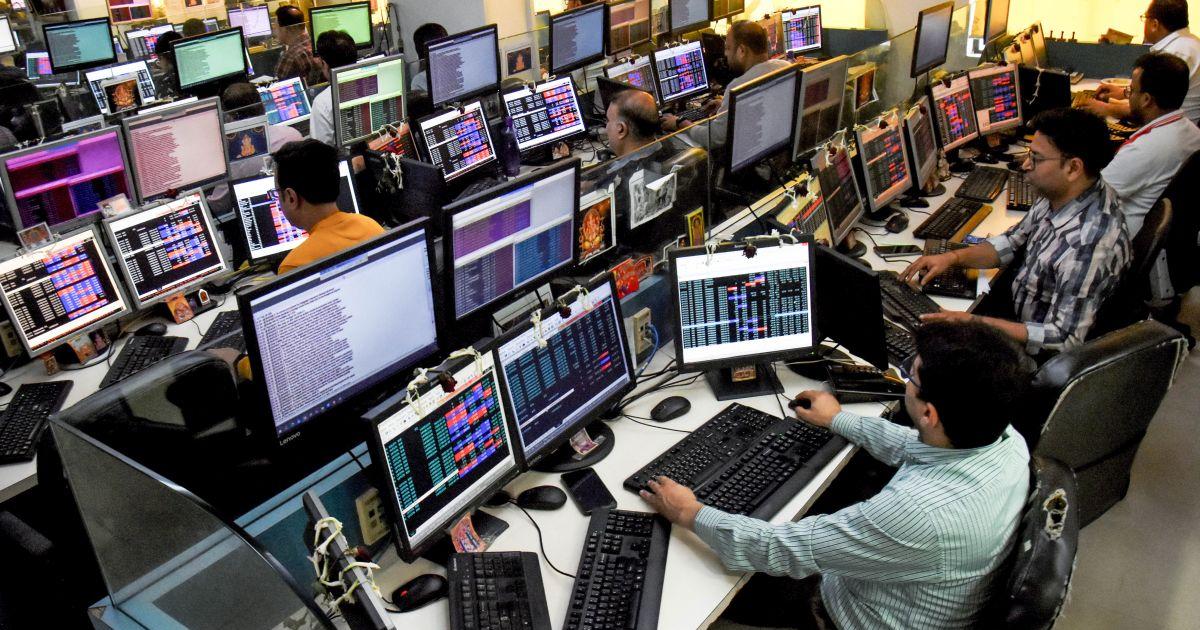
IMAGE: Shareholders and brokers monitoring the data during the Union Budget 2026-27 presented by Union Finance Minister Nirmala Sitharaman, in Kolkata on Sunday. Photograph: ANI Photo
Industry experts observed that the announcement of a tax holiday for data centres until 2047 and the expansion of the semiconductor mission will reduce investment uncertainty and improve capital confidence.
This, they stated, signals a clear intent to transform India into a ‘producer of digital value’ focused on deep-tech R&D and indigenous IP creation, rather than just assembly or service delivery.
Key Points
- India Inc sees Budget 2026-27 as a structural shift, treating AI as a horizontal enabler across sectors.
- The data centre tax holiday till 2047 and expansion of the semiconductor mission are expected to reduce investment uncertainty and boost capital confidence.
- Industry says the Budget signals India’s transition from a service-and-assembly base to a producer of digital value, deep-tech R&D and indigenous IP, with GCCs moving towards ownership roles.
Mahesh Makhija, Leader and Partner, Technology Consulting, EY India, termed the emphasis on large-scale capacity-building AI missions as a ‘structural shift’ in how India is preparing for an AI-driven economy.
“By prioritising talent development, research, compute infrastructure, data readiness, and mission-mode innovation together, the government is building the foundational layers for sustainable AI adoption rather than fragmented pilots,” Makhija said.
He added that this approach is capable of accelerating productivity across industries, strengthening indigenous innovation, and making public services more responsive and efficient. It signals that AI is being treated as a general-purpose technology that must permeate every sector of the economy.
Echoing this sentiment, S Anjani Kumar, Partner at Deloitte India, noted that the Budget treats AI as a ‘horizontal enabler’ for the entire economy.
“It explicitly positions it (AI) as a force multiplier for better governance alongside structural reforms and financial-sector deepening.
“On the ground, this shows up in very different domains: a multilingual Bharat-VISTAAR AI tool to integrate AgriStack and ICAR advisories for customised farm decision-support, AI-enabled matching of workers, jobs and training through the new Education-to-Employment Standing Committee, AI-driven risk assessment for scanning every container at major ports, and support for AI-integrated assistive devices under Divyang Sahara Yojana,” Kumar said.
Tax holiday seen positioning India as long-term AI hub
The parallel tax holiday and safe-harbour regime for global and domestic cloud providers using data centres situated in India signals a bet on India as a long-term compute hub, which is the infrastructure backbone for all this AI adoption.
If these strands are executed well, the long-term implication is an economy where productivity gains from AI are spread across agriculture, services, logistics and social protection, making India simultaneously more competitive and more inclusive rather than concentrating benefits in a single industry or vertical, he said.
Manpreet Singh Ahuja, Chief Clients Officer and TMT Leader, PwC India, said the Budget is a clear signal that India wants to be a ‘producer of digital value’.
“For the technology ecosystem, the most significant announcement is the intent to make India a global hub for cloud and data infrastructure-via a tax holiday till 2047 for foreign companies providing global cloud services using India-based data centre capacity,” Ahuja said, adding that this reduces uncertainty and improves capital confidence.
Manoj Kumar Singh, Director General of the Digital Infrastructure Providers Association (DIPA), believes the tax holiday is ‘bold policy-making’ that positions the country as a global hub while advancing its $3 trillion digital economy ambition.
“What’s truly significant is recognising digital infrastructure as the great enabler. Robust telecom networks and data centres don’t serve one sector-they power fintech innovations, telemedicine reaching villages, smart manufacturing, AI research, and digital governance. When we strengthen this foundation, we catalyse growth across every economic horizon,” Singh noted.
Budget bets on semiconductors, R&D
The expansion of the India Semiconductor Mission (ISM 2.0) and the 2047 Data Centre tax holiday prove that India is building for the next quarter-century, not just the next quarter. By simplifying tax compliance for mid-sized firms, the government has lowered the cost of doing business while raising the ambition of doing business, according to Nipun Kalra, India Leader-BCG X (Tech Build and Design Unit), BCG.
“Budget 2026 rewrites the contract between the state and Corporate India. It moves us from ‘assembling tech’ to ‘owning the stack.’ We are no longer just a service destination; we are becoming the world’s intelligence engine room, where AI and hardware skills will be the primary currency of the job market,” Kalra said.
Lakshminarayanan Ramalingam, COO, Quest Global, observed that the expansion of ISM 2.0, coupled with PhD funding, reflects an understanding that long-term competitiveness will be driven by ‘deep R&D, advanced skills, and indigenous IP creation rather than manufacturing alone’.
For Global Capability Centres (GCCs), the Budget is seen as a catalyst for moving up the value chain, transitioning from execution hubs to centres of ownership and accountability.
Sindhu Gangadharan, MD of SAP Labs India and Chairperson, Nasscom, emphasised that the focus on cloud infrastructure addresses the core constraints in scaling enterprise platforms.
“For GCCs, this creates the conditions to move beyond delivery into ownership, where India increasingly designs, builds, and runs core platforms and mission-critical systems for global enterprises,” Gangadharan said.
She noted that greater predictability in tax and compliance is critical for globally distributed teams, as ‘clarity reduces friction in decision-making and allows accountability for core platforms and products to sit firmly in one place’.
“We’re excited by MSME, infrastructure, DPI, AI readiness, GCC, and R&D initiatives-key enablers for customer success. ServiceNow is committed to India’s growth, driving productivity, resilience, and compliant innovation at scale,” Sumeet Mathur, MD, ServiceNow India Technology & Business Centre, said.