

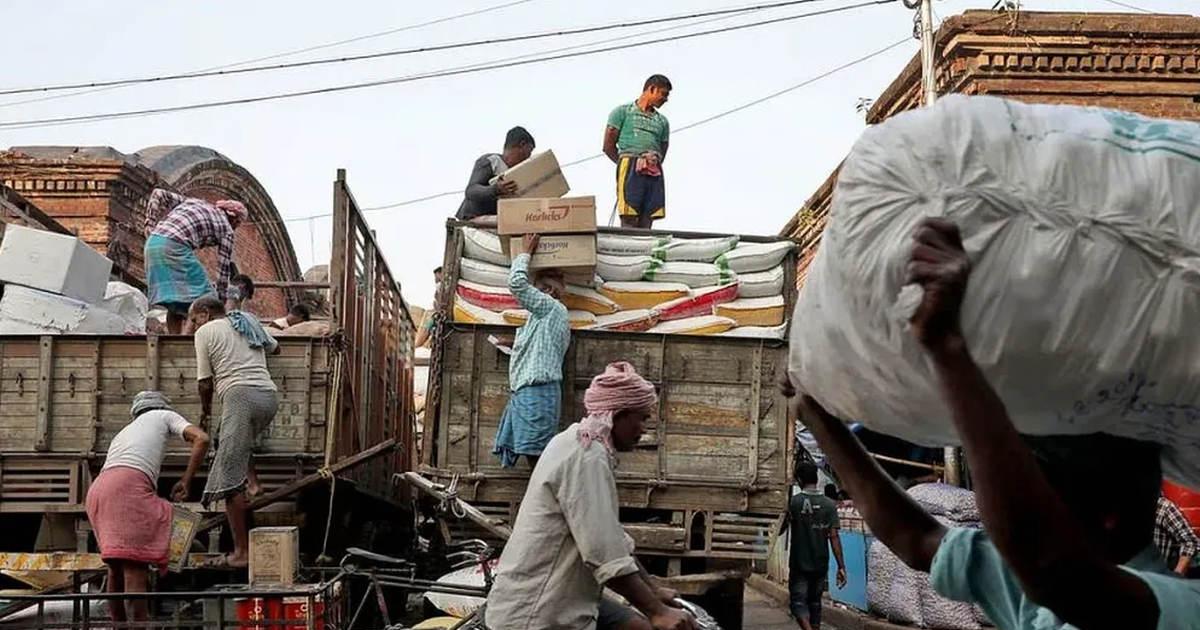
Despite global economic headwinds, the OECD forecasts robust GDP growth for India, projecting 7.6% for the current fiscal year and 6.1% in 2026-27, driven by factors like declining US tariffs but tempered by potential energy price shocks and gas rationing.
Photograph: Rupak De Chowdhuri/Reuters
Key Points
- The OECD projects India’s GDP to grow at 7.6% in the current fiscal year and 6.1% in 2026-27.
- The Middle East conflict poses economic risks, potentially disrupting global energy supplies and raising prices.
- Declining US tariffs are expected to support India’s growth, although gas rationing may disrupt some production.
- Inflation in India is projected to rise in 2026-27 due to increasing global energy prices.
- India may temporarily raise policy rates in 2026 to counter inflationary pressures, according to the OECD report.
The Organisation for Economic Cooperation and Development (OECD) on Thursday projected India’s GDP to grow at 7.6 per cent in the current fiscal and 6.1 per cent in 2026-27.
The OECD in its interim Economic Outlook report said the evolving conflict in the Middle East has “human and economic costs” for the countries directly involved, and will test the resilience of the global economy.
A halt in shipments through the Strait of Hormuz and the closure or damage of energy infrastructure has generated a surge in energy prices and disrupted the global supply of energy and other important commodities, such as fertilisers.
OECD’s Growth Projections for India
“The decline in (US) tariffs should support growth in India, though gas rationing will disrupt some production activities and fiscal support is expected to fade, with growth easing from 7.6 per cent in fiscal year (FY) 2025-26 to 6.1 per cent in FY 2026-27 and 6.4 per cent in FY 2027-28,” the OECD said.
The fading deflationary impact of past food and energy price-reducing shocks will be exacerbated by the recent surge in global energy prices, OECD said, which will push inflation up from 2 per cent in FY 2025-26 to 5.1 per cent and 4.1 per cent in FY 2026-27 and 2027-28, respectively.
Amongst the emerging-market economies, India is projected to raise policy rates temporarily in the second quarter of 2026 to help offset stronger inflationary pressures, the OECD report said.
Impact of US Tariff Changes
US bilateral tariff rates have declined following the US Supreme Court ruling against the tariffs imposed under the International Emergency Economic Powers Act.
There are particularly large reductions for several emerging-market economies, including India.
Nonetheless, the overall US effective tariff rate remains well above that prevailing prior to 2025.
Global Economic Outlook
The OECD report projected global GDP growth to ease to 2.9 per cent in 2026 before edging up to 3 per cent in 2027.
“The energy price surge and the unpredictable nature of the evolving conflict in the Middle East will raise costs and lower demand, offsetting the tailwinds from strong technology-related investment and production, lower effective tariff rates and the momentum carried over from 2025,” it said.

