
In such pacts, two sides reduce or eliminate import duties on over 90 per cent of goods traded between them.
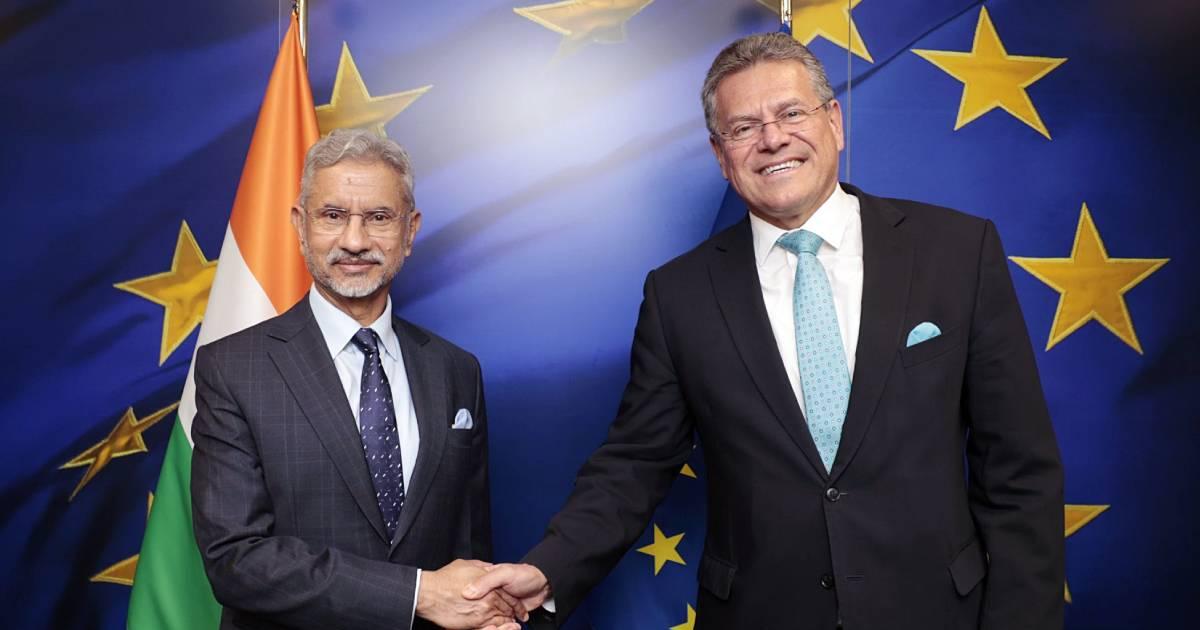
IMAGE: External Affairs Minister S Jaishankar meets European Commissioner for Trade and Economic Security Maroš Šefčovič in Brussels, June 11, 2025. Photograph: DrSJaishankar X/ANI Photo
Key Points
- The talks started in 2007
- Textiles and footwear), duties get eliminated immediately
- India’s bilateral trade in goods with the EU was $136.53 billion in 2024-25
India and the European Union are set to announce on January 27 the conclusion of negotiations and finalisation of a free trade agreement, which is aimed at boosting economic ties between the two regions amid disruptions in global trade due to US tariffs, an official said.
The pact is nearing the finishing line after 18 years. The talks started in 2007.
‘Mother of all deals’
Commerce and Industry Minister Piyush Goyal has termed this free trade agreement (FTA) “mother of all deals” the country has signed so far.
The conclusion of talks for the agreement will be announced in the India-EU (European Union) Summit, the official said.
European Commission President Ursula von der Leyen landed here on January 24 for a four-day visit.
President of the European Council Antonio Costa and von der Leyen will hold summit talks with Prime Minister Narendra Modi on January 27.
While India and the 27-nation bloc EU will announce closure of FTA talks this week, it will be signed after legal vetting of the text on a mutually agreed date.
Implementation of the deal may take some time as it requires approval of the EU parliament.
In India, it requires the nod of the Union cabinet only.
In such pacts, two sides reduce or eliminate import duties on over 90 per cent of goods traded between them.
On a number of products (like from labour intensive sectors such as textiles and footwear), duties get eliminated immediately on the first day of implementation of a trade pact.
On certain items, the duty gets eliminated or reduced in a phased manner over five, seven or ten years.
The two sides also provide quota-based market access for certain sectors like alcoholic beverages and automobiles (in case of trade deals with Australia and the UK), while no duty cuts are extended for sensitive goods like some agri products to protect small and marginal farmers.
Besides, an FTA also liberalises norms to promote trade in services sectors such as telecommunications, transportation, accounting, and auditing.
The NDA government has finalised seven trade pacts since 2014: Australia, the UK, Oman, New Zealand, the UAE, the EFTA bloc, and Mauritius.
Before that, several pacts were implemented, and those include the 10-nation Asean (Association of Southeast Asian Nations) bloc, Japan, South Korea, Malaysia, SAFTA (South Asia Free Trade Agreement), and Singapore.
India-EU pact will be the biggest
India’s pact with the EU will be the biggest, as the bloc comprises 27 developed countries.
The EU includes France, Germany, Spain, Italy, Austria, Belgium, Bulgaria, Finland, Hungary, Ireland, the Netherlands, Portugal, Poland, Denmark, and Sweden.
This pact is important, as the US’ imposition of high tariffs has disrupted global trade flows.
India is facing steep 50 per cent tariffs.
The FTA is expected to help Indian exporters diversify their shipments.
It will also help reduce dependence on China.
The EU market accounts for about 17 per cent of India’s total exports, and the bloc’s exports to India constitute 9 per cent of its total overseas shipments.
India’s bilateral trade in goods with the EU was $136.53 billion in 2024-25 (exports worth $75.85 billion and imports worth $60.68 billion), making the EU India’s largest goods trading partner. The services trade in 2024 was $83.10 billion.
As per reports, the EU, with a GDP of about $20 trillion and a population of over 450 million, is the major global trade player, exporting about $2.9 trillion and importing more than $2.6 trillion annually.
India, with a population of 1.4 billion, exported $437 billion in goods and $387.5 billion in services.
It imported goods worth $720 billion and services worth $195 billion in 2024-25.
Zero duty market access
India is looking at zero-duty market access for its labour-intensive sectors such as textiles, leather, handlooms, and some processed foods.
The EU, on the other hand, is seeking greater access to Indian markets for its auto exports, wines, and emerging high-tech manufacturing sectors.
Sensitive agriculture issues have been kept out of the deal.
The EU has been protective of its beef, sugar and rice markets.
India, on the other hand, has protected its farm and dairy sectors from competition, as the livelihoods of large numbers of small and marginal farmers depend on them.
Dairy has been excluded from all FTAs that India has signed so far.
Export and import of goods
India’s major goods exports to EU in FY2025 included petroleum products ($15 billion); electronics ($11.3 billion – smartphone $4.3 billion); textiles ($1.6 billion – garments $4.5 billion); machinery, computer ($5 billion); organic chemicals ($5.1 billion); iron and steel ($4.9 billion), gems and Jewellery ($2.5 billion); pharma ($3 billion); auto parts ($1.6 billion); footwear ($809 million); and coffee ($775 million).
The main imports included machinery, computer ($13.0 billion); electronics ($9.4 billion – mobile phone parts-$3.7 billion, ICs $890.5 million); aircraft ($6.3 billion); medical devices, scientific instruments ($3.8 billion); gems and jewellery ($3 billion – rough diamonds $1.7 billion); organic chemicals ($2.3 billion); plastics ($2.3 billion).
India’s key services exports to the EU were other business services, telecommunication and IT, transportation services.
Imports included intellectual property services, telecommunication and IT.
The EU is also a major investor in India. India’s cumulative FDI inflows from the EU during April 2000 to September 2024 were $117.4 billion with 6,000 EU firms present in India.
FDI from the EU represented over 16.5 per cent of the cumulative amount of FDI equity inflows from all countries.
India’s FDI outflows to the EU are valued at about $40.04 billion from April 2000 to March 2024.