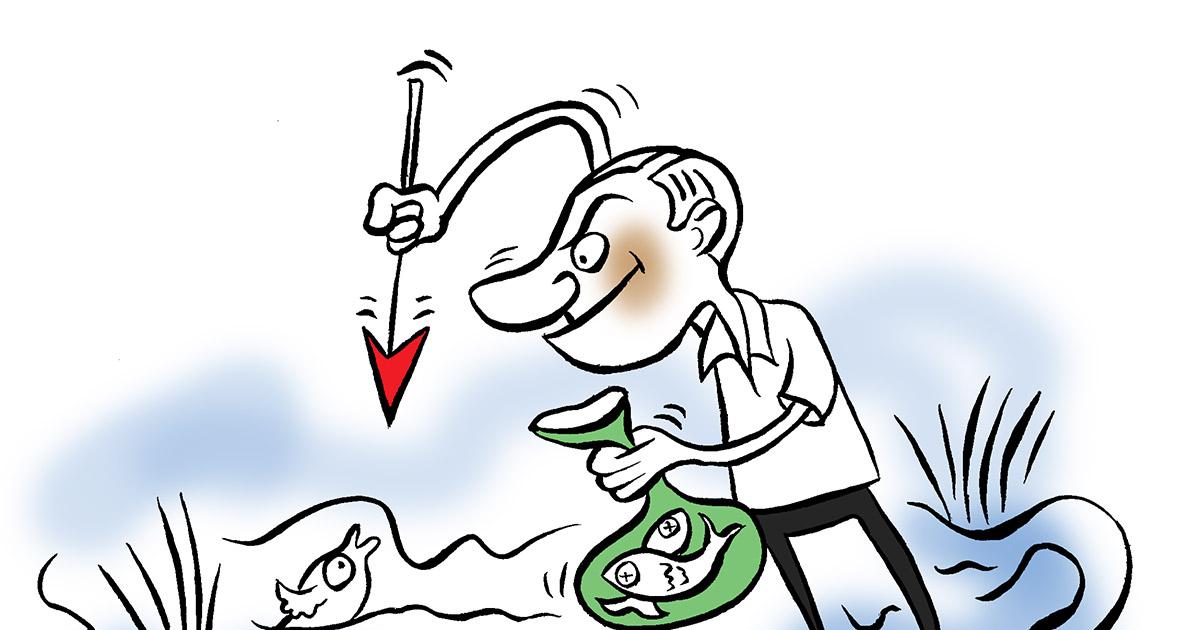


These losses increase insurance premiums for customers and reduce insurer margins on the other.

Illustration: Dominic Xavier/Rediff
The insurance industry has been witnessing Rs 8,000 crore to Rs 10,000 crore leak in annual claim payouts due to Fraud, Waste, and Abuse (FWA), with most of it being concentrated in the mid-ticket claim segment — between claim value of Rs 50,000 and Rs 2.5 lakh — according to BCG-Medi Assist Report.
Every year, 8 to 10 per cent of total claim payouts are estimated to be lost to FWA, translating to leakages amounting to approximately Rs 8,000 crore to Rs 10,000 crore annually.
According to the report, if the industry curbs these losses, insurers can directly preserve profitability, recovering margins that are currently eroded by avoidable inefficiencies.
Fraud refers to intentional deception or misrepresentation for financial gain.
Waste arises from inefficiencies or avoidable costs, such as delayed discharges caused by the unavailability of doctors over the weekend.
Abuse, though not always fraudulent, involves practices inconsistent with accepted business or clinical standards, for example, overcharging for routine services or billing for a higher category of room than what was provided.
An analysis of insurance profitability indicates that a 100 basis points (bps) reduction in FWA could uplift sectoral RoE (return on equity) by 70 to 80 bps, making the sector more attractive, enabling greater capital realisation, expanding coverage, and improving risk pool resilience.
Reducing FWA by only 50 per cent could also drive an approximately 35 per cent improvement in sectoral RoE, thereby enhancing overall profitability and sustainability.
“As India’s health system stands at an inflection point,” Satish Gidugu, CEO, Medi Assist, said, “the next decade will be defined by connected data and intelligent automation.”
At the heart of this transformation, both technology and AI are enabling insurers to proactively identify and reduce FWA, translating into direct cost savings and improved operational efficiencies.
“Each year, an estimated Rs 8,000 crore to Rs 10,000 crore of claim payouts leak through FWA, which erodes insurer margins, inflates customer premiums, and strains public resources,” Gidigu pointed out.
“Therefore, the need of the hour is to ensure that we forge digital trust and transparency into our health insurance infrastructure, thereby ensuring that care remains accessible, affordable, and accountable for all citizens.”
These losses act as a double-edged sword by increasing insurance premiums for customers on the one hand, and reducing insurer margins on the other.
Thus, the Indian insurance sector finds itself caught in a downward spiral.
According to the report, the compounding effect of FWA contributes directly to rising healthcare inflation, which then drives higher premiums and erodes affordability.
Rising insurance premiums hinder insurance penetration, pushing citizens to pay out-of-pocket (OOP), which also worsens the overall health outcomes, forcing to resort to non-compliances in treatment, delayed or avoided care, and underutilisation of preventive care, further deepening the spiral of higher costs, reduced access, and declining system resilience.
‘The downward spiral might also weaken key government initiatives, and keep insurer finances under strain. Margins remain thin, with most standalone and general insurers posting single-digit returns. The loss of input tax credit (ITC) under goods and services tax (GST) 2.0 has further squeezed profitability,’ the report said.
As fraudulent activity rises, more claims are flagged for investigation, and in the process, even legitimate claims undergo extended scrutiny, thereby diluting the experience for genuine policyholders.
This erosion of trust between insurers, providers, and customers gradually weakens confidence in the system, discouraging participation and further leading to lower insurance penetration.
Across the insurance journey, FWA persists because of issues like limited visibility, uneven processes, and misaligned incentives.
When information is scattered, steps vary across players, and consequences are uncertain, misuse becomes easier and more likely.
‘These conditions allow errors, overuse, and opportunistic behaviour to keep recurring. As we move from incidence patterns to underlying causes, it becomes clear that there are systemic barriers that allow FWA to persist, explaining why the problem remains pervasive despite repeated industry efforts, the report said.
“In India’s health insurance landscape, about 90 per cent of claims are risk-free while 2 per cent are outright fraudulent and continue to be flagged today,” Swayamjit Mishra, managing director and partner, core member financial services and technology lead in insurance, Asia-Pacific, BCG, said.
“The real opportunity lies in the remaining 8 per cent, where inefficiencies and abuse can be addressed without inconveniencing genuine policyholders,” Mishra added.
“Harnessing digital intelligence, interoperable platforms, and next-generation technology, we can systematically target this segment to reduce fraud leakage, improve trust, and unlock significant value across the ecosystem,” Mishra stated.
“These efforts can advance the government’s ‘Insurance for All’ vision by nearly five years, strengthening India’s journey towards a transparent, technology-driven, and sustainable health insurance system.”

Feature Presentation: Aslam Hunani/Rediff