

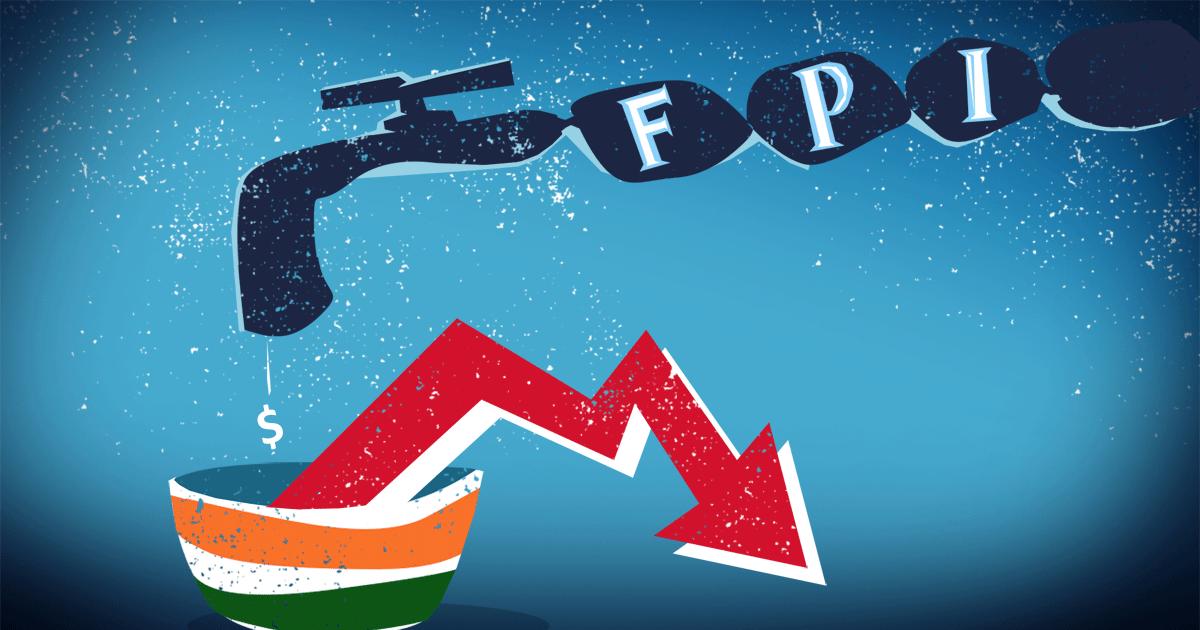
Foreign investors are aggressively divesting from Indian equities, with significant outflows driven by escalating geopolitical tensions in West Asia, rising crude oil prices, and persistent global inflation concerns, impacting the Indian economy.

Illustration: Dominic Xavier/Rediff
Key Points
- Foreign investors withdrew over ₹48,213 crore from Indian equities in the first 10 days of April, adding to a record ₹1.17 lakh crore outflow in March.
- Escalating geopolitical tensions in West Asia, rising crude oil prices, and global inflation concerns are the primary drivers of this aggressive sell-off.
- The energy crisis from the West Asia conflict and the continued depreciation of the rupee are keeping Foreign Portfolio Investors (FPIs) in a selling mode.
- Markets in South Korea and Taiwan are currently more attractive to FPIs due to stronger earnings growth outlooks compared to India’s modest expectations.
- A reversal in FPI flows hinges on the credible reopening of the Strait of Hormuz, stabilisation of the rupee, and positive surprises from India’s Q4 earnings season.
Foreign investors maintained their aggressive sell-off in Indian equities, withdrawing Rs 48,213 crore ($5.14 billion) in the first 10 days of April, as rising geopolitical tensions and global macroeconomic uncertainties reduced risk appetite.
The sell-off follows a record outflow of Rs 1.17 lakh crore (about $12.7 billion) in March, the worst monthly exodus on record.
The sharp reversal comes after FPIs had infused Rs 22,615 crore in February, marking the highest monthly inflow in 17 months.
Total Outflows Surge in 2026
With the latest withdrawals, total outflows by foreign portfolio investors (FPIs) have surged to Rs 1.8 lakh crore in 2026 so far.
In April alone, foreign investors withdrew equities worth Rs 48,213 crore from the cash market till April 10, according to NSDL data.
Factors Driving the Sell-Off
Market participants attributed the sustained selling pressure to a combination of global macroeconomic headwinds and heightened geopolitical risks.
Himanshu Srivastava, Principal – Manager Research at Morningstar Investment Research India, noted that selling was largely driven by risk aversion triggered by escalating tensions in West Asia, which pushed up crude oil prices and revived concerns about inflation globally.
Echoing similar concerns, VK Vijayakumar, Chief Investment Strategist at Geojit Investments, said the energy crisis stemming from the West Asia conflict, coupled with the potential spillover impact on the Indian economy and continued depreciation of the rupee, has kept FPIs firmly in sell mode.
He also pointed out that markets such as South Korea and Taiwan are currently more attractive to FPIs, given their stronger earnings growth outlook compared to the relatively modest expectations for India in FY27.
Potential Reversal of Flows
Even the recent US-Iran ceasefire failed to arrest the selling momentum.
“FPIs used the relief rally as a liquidity window to exit further,” said Vaqarjaved Khan, senior fundamental analyst at Angel One.
According to Khan, a reversal in flows would depend on three key factors — credible reopening of the Strait of Hormuz, stabilisation of the rupee, and a positive surprise from India’s Q4 earnings season.
“Flows can reverse quickly, but only if macro conditions begin to support the shift,” he added.