

‘There is a lot of euphoria in the country after a trade agreement is signed. But it is an illusion for us. What is more important is making it real.’

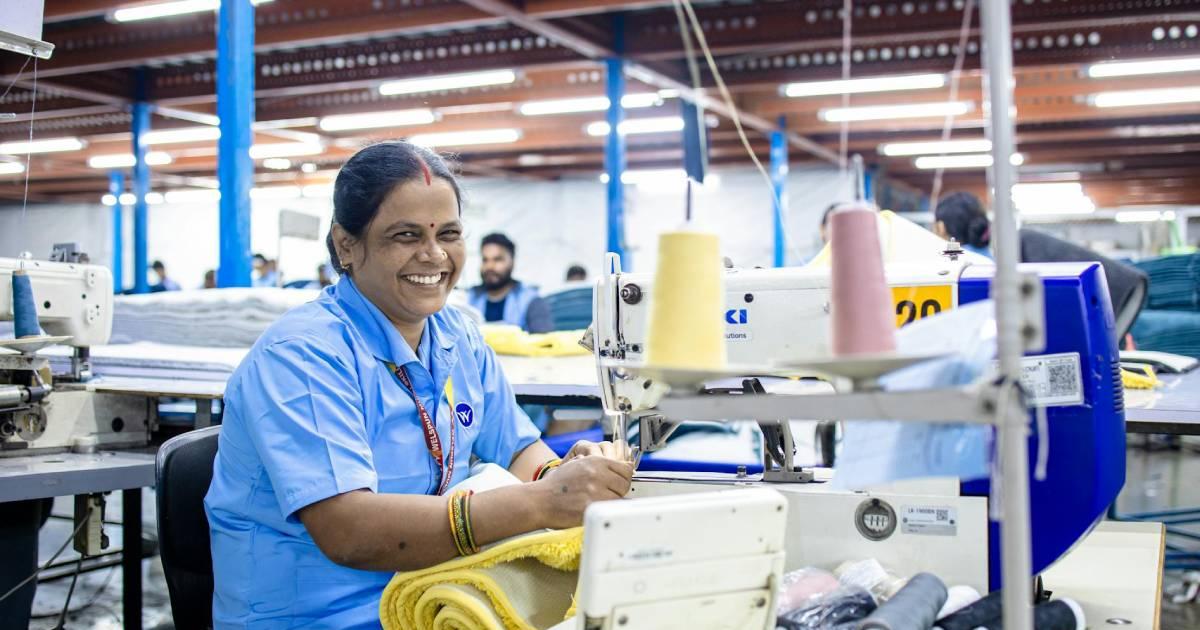
Kindly note the image has been posted only for representational purposes. Photograph: Kind courtesy EqualStock/Pexels.com
Tirupur is home to around 5,000 textile units. Textiles exports from this Tamil Nadu town was around Rs 40,000 crore ($4.8 billion) in 2025.
45 per cent of the textiles exports from Tirupur is to the European Union worth $1.74 billion; it is around $1.2 billion to the UK.
With India signing a Free Trade Agreement (FTA) with the EU on January 27, 2026, exports to the EU is expected to rise exponentially.
A couple of days ago, United States President Donald John Trump reduce the US’ trade tariffs against India from 50 per cent to 18 per cent.
The sour point for exporters is that the FTA India signed with the UK in May 2025 is yet to get implemented.
Global trade expert Ajay Srivastava told Rediff after India signed the FTA with the EU that it may take at least one year for day one of the free trade agreement to begin.
This is what worries the textile manufacturers of Tirupur, says Raja M Shanmugam, former president, Tirupur Exporters Association.
“If the government will not support us with funds, buyers will abandon us and move over to some other country for the next placement of orders,” Raja M Shanmugam tells Rediff‘s Shobha Warrier.
EU-India FTA boost for Tirupur exports

Kindly note the image has been posted only for representational purposes. Photograph: Kind courtesy EqualStock/Pexels.com
From April to December 2025, textile exports from India declined by 2.19 per cent but apparel exports had a growth of 2.36 per cent. But it was down by 12.9 per cent in October 2025 after Trump slapped huge tariffs on India. What changed between October and December?
In October, there was panic in the market after Trump announced huge tariffs.
Another factor is because of the festival holidays in India, there was a reduction in shipments from here.
Naturally, exports dipped badly.
After October, exports went up. But you have to note that only the confirmed orders got exported, that too with heavy discounts. And it happened only because brands were forced to take goods out of India as they couldn’t replace them by some other source immediately.
All this panic and slump in exports in October was because of Trump’s tariff and festival holidays in India.
In the months after October, exports went up not because there were new orders but because the existing confirmed orders got ready only by then. They were shipped out in a phased manner with heavy discounts to the US.
Trump tariffs hit Tirupur apparel industry
Only to the US?
The slump in exports was only because of the tariffs imposed by Trump.
Exports to Europe and other regions were going smoothly, in fact with a marginal increase.
Only the goods to the US got into problem because of the imposition of a tariff of 50 per cent.
After the high tariffs, we had only exported earlier orders to the US, that too with discounts borne by both the buyers and manufacturers.
There has been no fresh orders from the US. They got stopped completely.
UK FTA delay worries textile exporters
How much has Trump and his tariffs affected the atmosphere and the mood of Tirupur’s textile industry?
Tirupur would be the litmus test for the whole of India in the apparel segment.
Tirupur got impacted to the tune of 34 per cent because our exports to the US market hovers around 30 to 34 per cent and that has got into jeopardy after Trump came to power.
Now, we have to manage with the other available markets to survive or sustain themselves. Yes, it is a tough situation for more than 5,000 factories in the Tirupur cluster.
Zero-tariff access to EU in focus
It is said that 45 per cent of your textile exports go to the EU. Then, you have the UK market too. So, has loss of 34 per cent to the US affected Tirupur very badly?
34 per cent is a huge chunk of our exports!
Obviously it will create a tight financial situation for all of us.
It has almost killed the community and the cluster.
That’s why we have frantically appealed to the Government of India to help us tide over this situation with some incentives.
This has happened due to no fault of ours. It is a geopolitical situation.
Till the government settled a deal with the US, we wanted the government to handhold the MSMEs.
In fact, across the globe, every country is moving towards protectionism.
If the government will not support us with funds, buyers will abandon us and move over to some other country for the next placement of orders.
Tirupur’s migrant workforce under pressure
Has it happened already? Vietnam, which has an FTA with the EU, has an advantage over India.
FTA creates an advantageous position for all our competitors while it is a disadvantage for a country like India which has no FTA. It is not a level playing field.
While we are hit by a 12 per cent tariff from Europe, countries like Vietnam has zero tariff. This 12 per cent tariff disadvantage was killing India.
MSME support demanded by textile cluster
Now, you must be happy with the EU-India trade deal…
Luckily, now there is an FTA between the European Union and India. But we do not know when it will be implemented. Only signing an agreement between EU and India has happened.
Remember a trade agreement between India and the UK was signed more than a year back. Till today, it has not been implemented.
You have to highlight this issue because there is a lot of euphoria in the country after a trade agreement is signed. But it is an illusion for us. What is more important is making it real.
The UK parliament is yet to pass the trade agreement with India.
Similarly, the trade deal with EU has to be passed by 27 countries.
What India should do is to assign a team to persuade the respective countries to do it as early as possible.
Regarding happiness, Tirupur is notionally happy. Real happiness will happen only when the deal moves from the paper to the ground.
Vietnam gains edge with EU zero tariff

Kindly note the image has been posted only for representational purposes. Photograph: Kind courtesy EqualStock/Pexels.com
Many experts feel that it may take at least one year for the EU-India trade deal to get implemented. Do you feel one year is a long period, and it will affect export clusters like Tirupur badly?
Yes, it will. We should not get carried away by just signing a trade agreement.
What is important is its implementation at the earliest.
Instead of letting them work at their own place, India should take the initiative and make it faster as we need the deal.
An agreement alone will not change the ground situation.
I also admit that if we have been travelling through a dark tunnel without seeing any light, at least we see light at the end of the tunnel.
But we want to reach the end as quick as possible.
Rising domestic demand for Indian apparel
Do you think the trade agreements with EU was the reason why Trump agreed to reduce trade tariffs to India from 50 per cent to 18 per cent?
Yes, the US president was compelled to have a trade agreement with India only because of the EU-India deal. That too, over the phone!
He understood that a union of the Indian market and European market would be a game changer globally. Not commercially, but politically too.
The EU deal will definitely boost the export of Indian products across the globe. Now, many other countries are also queuing up to fetch a deal with India.
The textile industry is very labour intensive. Do you feel with the EU deal, more labour intensive businesses are going to get a boost in India?
Yes. India is the youngest nation in the world when you look at it from the perspective of labour.
The western world or the so-called developed world is ageing, and there is no labour available there.
This is going to be a big factor for their economy.
So, they want to ally with India which has a population of 1.4 billion.
They have realised that continuing to depend on China is not a good idea.
So, I feel they will start using the expertise of the people of India more, not just in technology but in manufacturing too.
It will be a mutually beneficial situation.
The UK and EU together, how big will be the market for textiles exports?
For the Tirupur apparel export segment, the UK and EU markets together will contribute to over 75 per cent of our exports.
We already have 0 per cent deals with Australia and Japan.
For the apparel segment, I think we have FTA for 90 per cent of our exports.
This is a very positive sign for the textile industry as a whole.
Let me reiterate that what is more important is the implementation of the deals, and not just signing them.
Do you think dependence on the US market will reduce because of their big bully attitude?
I want to highlight another point. The Indian market itself is growing rapidly.
We have 1.4 billion people. Europe and America together constitute around 0.75 billion only.
 IMAGE: Raja M Shanmugam. Photograph: Kind courtesy Raja M Shanmugam
But do they not have more purchasing power?
I agree their purchasing power is more. But India’s purchasing power is also increasing day by day.
That’s why the western world is eyeing the Indian market. As we have a huge consuming population, all the major brands want to spread their wings here… European brands, American brands…
This is going to be an added advantage for India.
For example, Tirupur already has a turnover of around Rs 40,000 crore for exports.
And our domestic demand is surging high. There is a possibility of another Rs 40,000 crore business domestically too very soon.
I feel within a year, the domestic demand will be around Rs 50,000 crores, and exports will be around Rs 40,000 crore.
Earlier you said, every country wants protectionism now. Three decades ago, everybody talked about only globalisation, a world without borders, liberalisation, etc. Suddenly walls between countries have come up…
Now that the US is moving away from globalisation, all the other countries are pursuing businesses in their own way.
That’s why deals between countries are happening.
Earlier, we saw a US-led globalisation, but now a common ground is created between countries for globalisation, and the common ground is through special FTAs between trading communities or countries.
This is also globalisation, but only the alignment is changing, a realignment.
Key Points
- Tirupur’s apparel exporters were badly hit after the US imposed steep tariffs, wiping out fresh orders from the American market.
- Nearly 45% of Tirupur’s exports go to the EU, and exporters expect a major boost once the EU-India FTA is implemented.
- Delay in implementing the UK-India FTA and the new EU deal is creating uncertainty for the textile cluster.
- Exporters are seeking urgent government support to help MSMEs survive the current slowdown.
Feature Presentation: Ashish Narsale/Rediff