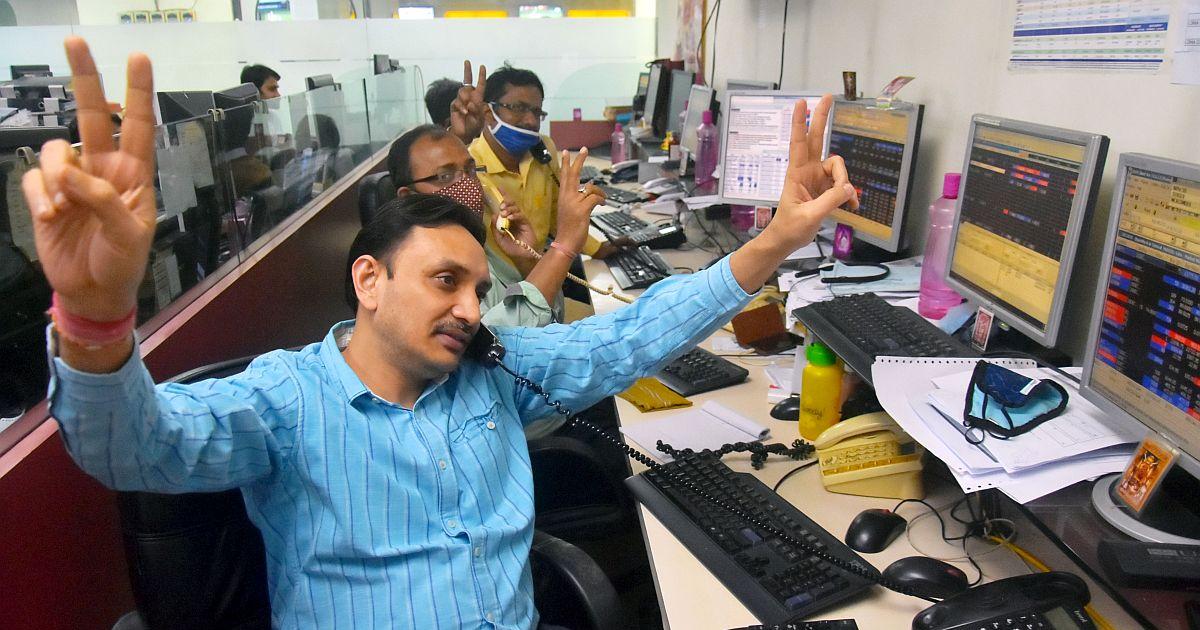


India witnessed an 11-month low in new demat account additions in March, as escalating geopolitical tensions and significant equity market declines dampened investor sentiment and moderated overall growth in FY26.

Illustration: Uttam Ghosh
Key Points
- New demat account additions in March fell to an 11-month low of 2.15 million, significantly below the 12-month average of 2.7 million.
- The slowdown is linked to the equity markets’ sharpest monthly decline since March 2020, with the Sensex and Nifty dropping over 11 per cent in March.
- Overall demat account growth moderated in FY26, with net additions slowing to 32 million, a 22 per cent decline from the record 41 million in FY25.
- Lacklustre equity market performance, heightened volatility, and reduced retail participation in IPOs contributed to the dampened investor appetite.
- Despite the moderation, structural tailwinds like financialisation of savings and digital adoption are expected to support normalised demat account growth in FY27.
The pace of new demat account additions in March hit an 11-month low, following the equity markets’ sharpest monthly decline since the pandemic-led rout of March 2020.
This slump came amid escalating tensions in West Asia, which drove up crude oil prices and clouded India’s prospects for growth and inflation.
About 2.15 million new accounts were added — the lowest since April 2025 and also below the 12-month average of 2.7 million.
Market Decline and Investor Sentiment
In March, the Sensex and the Nifty dropped more than 11 per cent. Overall growth also moderated in FY26, as weaker market returns and volatility weighed on retail sentiment. Net additions slowed to about 32 million in FY26, even as the total number of demat accounts crossed 225 million, according to data from depositories NSDL and CDSL. This marks a 22 per cent decline from FY25, when a record 41 million accounts were added, driven by a strong bull run, robust activity in initial public offerings (IPOs), and heightened retail participation.
Impact of Market Performance and Volatility
The moderation comes against the backdrop of lacklustre equity market performance. India’s benchmark indices logged their weakest showing in six years in FY26, with the Nifty 50 declining 5.1 per cent and the Sensex falling 7.1 per cent. The Nifty Midcap 100 gained 1.9 per cent, while the Smallcap 100 fell nearly 6 per cent. Heightened volatility further dampened investor appetite. Global uncertainties sustained foreign portfolio investor outflows and geopolitical tensions, triggered intermittent corrections in domestic equities.
Primary Market and Future Outlook
The primary market, a key driver of account openings in FY25, also saw a shift in momentum. While FY26 was a record year in terms of fund mobilisation — 112 IPOs raised ₹1.8 trillion — investor enthusiasm moderated. Average listing gains dropped sharply to 8 per cent from 30 per cent a year earlier, while retail participation weakened, with average IPO applications falling to 1.3 million from 2.13 million, according to Prime Database. Average daily turnover in the cash segment declined 6 per cent year-on-year to ₹1.13 trillion. While derivatives turnover rose modestly, activity on the NSE showed signs of strain. Demat account growth in FY27 is expected to remain steady but more normalised. Structural tailwinds such as financialisation of savings, digital adoption, and expanding investor awareness will support additions, though subdued returns and softer IPO traction may keep the pace below FY25 highs.