

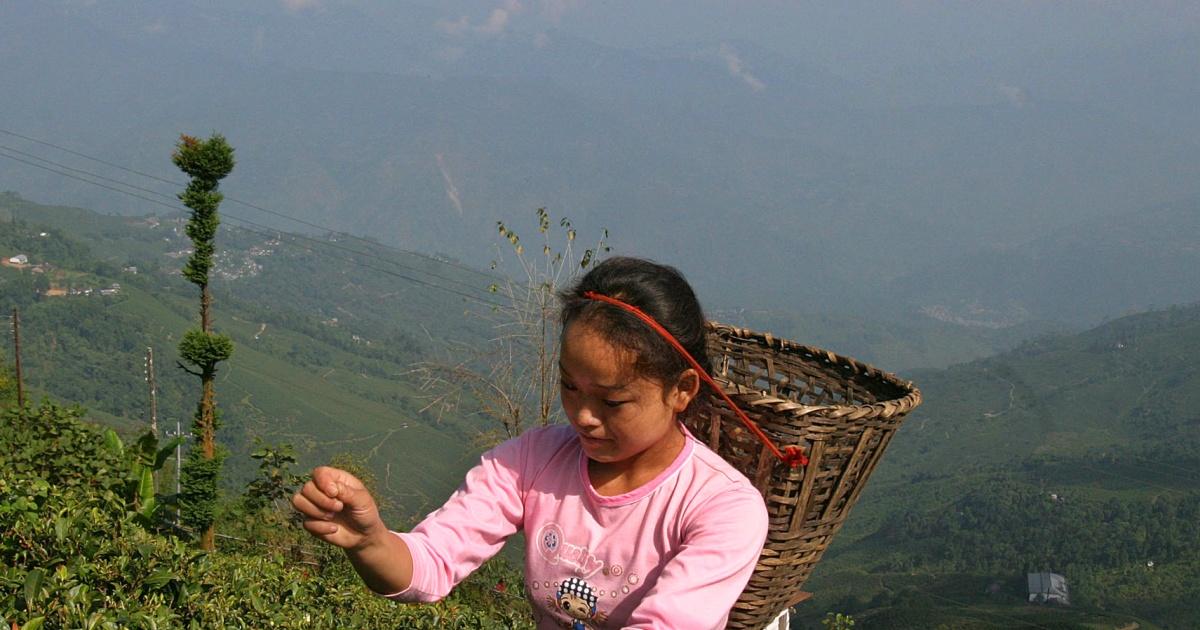
The famed Darjeeling tea may have slipped to a new production low in 2025, as changing weather patterns, a shortage of pluckers and mounting economic stress weigh on the region’s gardens.
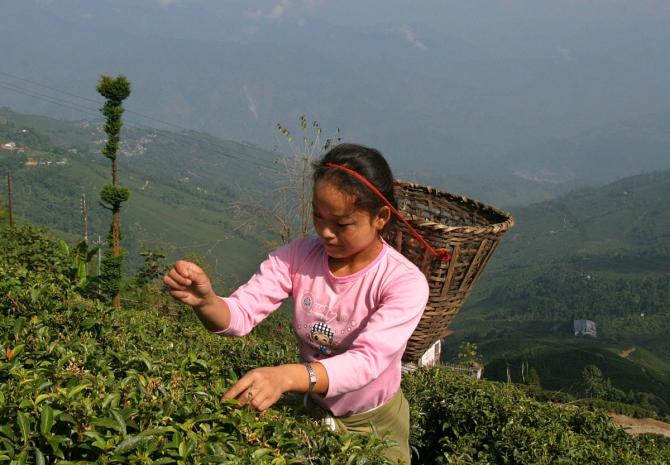
IMAGE: A worker gathers tea leaves at the Happy Valley tea garden estate in Darjeeling. Photograph: Rupak De Chowdhuri/Reuters
Data from the Tea Board website shows that production from January to November of 2025 was at 5.19 million kg (mkg) compared to 5.69 mkg in the same period of 2024, down 8.79 per cent year-on year.
And the output is unlikely to increase substantially as the tea production ceases in November. Barring 2017, when production crashed to 3.2 mkg due to the Gorkhaland stir that paralysed the region and shut the industry for a record 104 days, the production has never been so low.
C Murugan, deputy chairperson of Tea Board said, “We are closely monitoring the production.
“By next month, we will get the figure for calendar year 2025.”
Unlike in 2024, when the Tea Board declared an early closure for North India gardens by November 30, no such closure was announced in 2025, he added.
Industry sources, however, said that for all practical purposes, Darjeeling ceases tea production from the end of November.
Closure norms apply to the plains, said BK Laskar, senior advisory officer at the Tea Research Association’s Darjeeling Advisory Centre.
“In Darjeeling, production effectively ends by the last week of November due to weather and temperature conditions.”
Indian Tea Association (ITA) secretary general Arijit Raha said, Darjeeling tea production appears to have reached an unprecedented low.
A now-familiar slide
A new production low in 2025 would hardly be unexpected for Darjeeling, whose fabled gardens– home to the “champagne of teas” — have been hitting fresh lows year after year.
Production, which was 14.49 mkg in 1990, has been on a steady downward trajectory since.
The current output of 5.19 mkg reflects the cumulative impact of problems that have built up over the years, Laskar said.
Myriad challenges
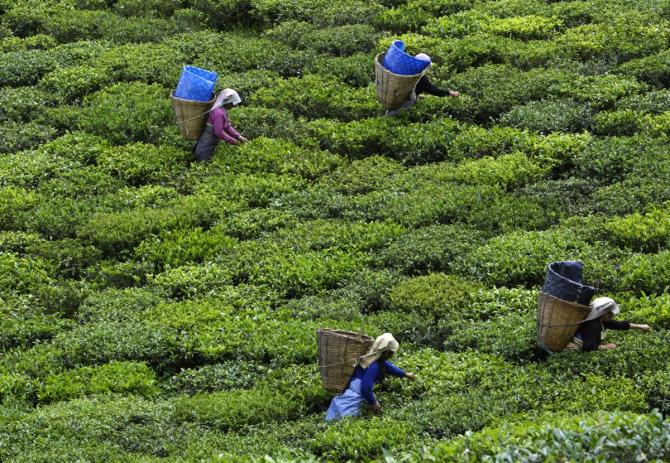
IMAGE: Tea garden staff pluck tea leaves at the organic tea garden. Photograph: Tim Chong/Reuters
It’s not a single issue.
Darjeeling is grappling with a host of challenges.
Most tea bushes in Darjeeling are old, with nearly 80-90 per cent of gardens dating back over 70 years and some more than a century old.
Tea garden owners need to do replantation and rejuvenation, said Murugan.
“However, replanting is typically carried out only in limited areas because of the region’s difficult topography.
“Moreover, it requires a lot of capital, so garden owners have to take a call.”
Also, most gardens in Darjeeling have turned to organic production.
“This again results in lower yields,” Murugan added.
Weather woes deepen
The weather last year was erratic and challenging, with high daytime temperatures in some months and incessant rainfall and low sunshine hours in other periods of the season, said Shaibal Dutt, managing director and chief executive officer of the Goodricke Group.
The Darjeeling district experienced a significant rainfall deficit in the early part of last year, Raha noted.
“Furthermore, the flash floods and landslides triggered by heavy rainfall in North Bengal in October 2025 severely impacted tea gardens in the western part of the Darjeeling hills, notably in areas such as Mirik and Pokhriabong.”
This resulted in reported losses of plantation areas and crops, particularly during the autumn flush period, he said.
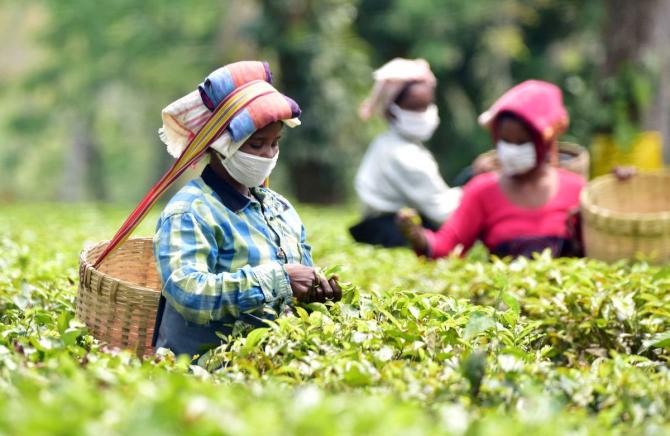
Photograph: ANI Photo
“Temperatures recorded in parts of Darjeeling in September and October 2025 were higher than in previous years, which may have impacted the crop.”
Adverse weather has been taking a toll for some time.
Average temperatures during the March–July growing season have increased by 1–1.5 degrees Celsius in the last seven years, Laskar said.
Labour absenteeism is yet another overhang for Darjeeling. Most gardens face an acute shortage of labour and are unable to pluck the tea areas properly, pointed out Goodricke’s Dutt.
According to Anshuman Kanoria, chairman, Indian Tea Exporters Association, it’s the biggest factor weighing on production.
“Gardens face absenteeism of 40-50 per cent, temporary labour is nearly impossible to find, and hiring pluckers from the plains is prohibitively expensive.
“As a result, both crop volumes and quality are suffering,” he added.
That is why production has fallen from a peak of 14mkg to about 5 mkg, observed Vikash Kandoi, executive director, Jay Shree Tea & Industries.
“Government intervention is needed to support Darjeeling tea, particularly through incentives for replantation and marketing.
“Otherwise, the industry risks a slow decline towards extinction,” said Kandoi.
He also pointed out that the rain flush which is mainly for the domestic market was being replaced by cheaper teas from Nepal.
“That is the crux of the issue.”
His views were echoed by Kanoria.
“Climate change and dumping from Nepal compounds our issues,” he said.
Defying demand-supply dynamics
The basic demand-supply theory is not holding for Darjeeling, said the largest producer of Darjeeling tea, Ashok Lohia of Chamong Group.
“In Kenya, a surplus of nearly 200 million kg took about two years to be absorbed, after which stocks began to decline and prices started rising.
“But in Darjeeling, falling production hasn’t resulted in higher prices,” he observed.
Data from the Calcutta Tea Traders Association (CTTA) shows that the average price of Darjeeling leaf teas sold in Kolkata auctions in 2025 was Rs 420.89 per kg whereas the average cost of production is approximately Rs 650 per kg.


